For decades, the traditional commission split model has been treated as the default system of salon compensation. It was simple, attractive to talented stylists, and easy to calculate on the back of a napkin. A stylist brought in the client, executed the service, and split the gross revenue right down the middle with the house. However, as the beauty and wellness economy changes, this payroll structure is causing many well-meaning salon owners to lose income.
The economic realities of running a modern hair salon, barber shop, or nail lounge have evolved dramatically, but in some cases, compensation structures are dangerously stuck in the past. Today’s salon owners find themselves caught in a vice: consumer expectations for premium, hyper-hygienic spaces require heavy capital investments, product manufacturing costs are steadily rising, and localized marketing demands sophisticated, paid digital customer-acquisition strategies. If you are still paying out flat, unengineered commission splits based solely on gross revenue, you are likely overpaying your team at the direct expense of your business's stability.
Creating a sustainable pay structure is not about reducing your team’s earning potential or undervaluing their creative labor. On the contrary, a mathematically sound compensation model protects your staff by ensuring the storefront they rely on remains profitable, well-capitalized, and capable of driving fresh client traffic to their chairs. This guide breaks down the true math behind sustainable salon compensation, exposing the hidden drains of the flat 50/50 split and providing the exact mathematical blueprint needed to hardcode profitability directly into your payroll system.
The flat 50/50 commission split is a relic of a bygone era when commercial real estate was cheap, backbar products were inexpensive, and digital marketing did not exist. In that landscape, a salon owner could comfortably take their 50% share and count on it to cover basic utilities and rent, leaving a healthy net profit margin.
Today, that math is completely broken. When you give away 50% of your gross top-line service revenue instantly, you are forcing the remaining 50% of that single dollar to bear the entire, compounding weight of the salon’s modern operational overhead.
To see why the 50/50 model fails, look closely at the realistic overhead cost structure of a modern commercial salon space. Before a stylist even picks up their shears or touches a client's hair, your business is consuming cash to keep that square footage functional.
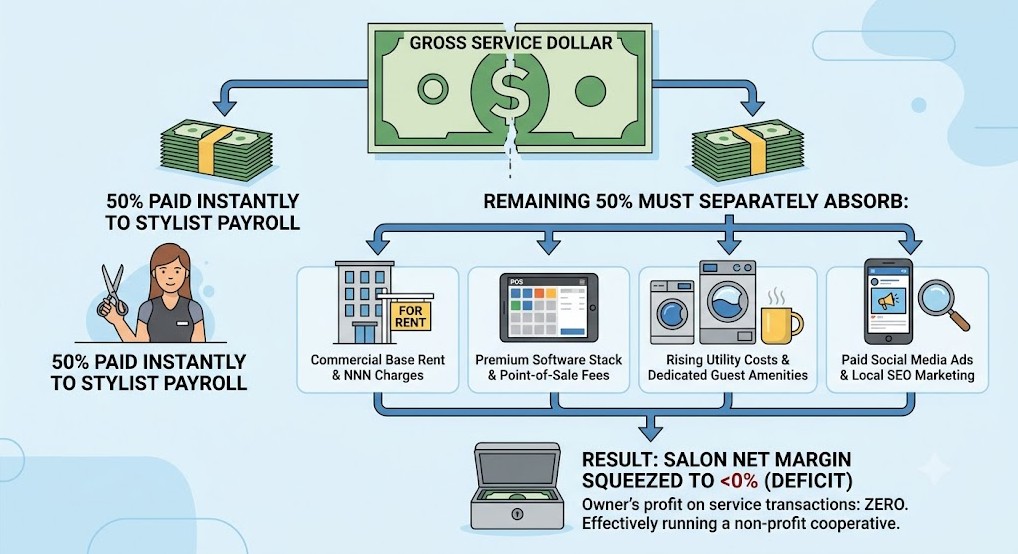
Commercial base rents, paired with Triple Net (NNN) charges, have risen substantially across major US markets. Concurrently, utility bills—driven by high-consumption wash stations, continuous laundry cycles, and advanced climate control systems—have steadily inflated.
In the meantime, client acquisition has evolved from passive walk-in traffic to a highly active, paid operation. A modern salon must invest heavily in local search optimization, ongoing social media ad campaigns, software-driven booking platforms, and high-end guest amenities such as specialty coffee bars and premium retail displays.
When you analyze these expenses on a per-chair, per-hour basis, you quickly realize that the 50% share left for the house is almost entirely wiped out before you even touch your product inventory. If the house’s half of the revenue is fully consumed by fixed operational costs, the owner is left making zero profit on service transactions, effectively running a non-profit cooperative for their employees.
The final blow to the 50/50 model is a critical accounting oversight made by many creative entrepreneurs: ignoring employer-side payroll taxes and mandatory insurance. When you hire an employee on a standard W-2 framework in the United States, their stated commission rate is never your actual labor cost.
As an employer, you are legally obligated to match Federal Insurance Contributions Act (FICA) taxes, which include 6.2% for Social Security and 1.45% for Medicare. On top of that baseline, you must absorb Federal Unemployment Taxes (FUTA), State Unemployment Taxes (SUTA), and local workers' compensation insurance premiums, which are calculated directly as a percentage of your total gross payroll.
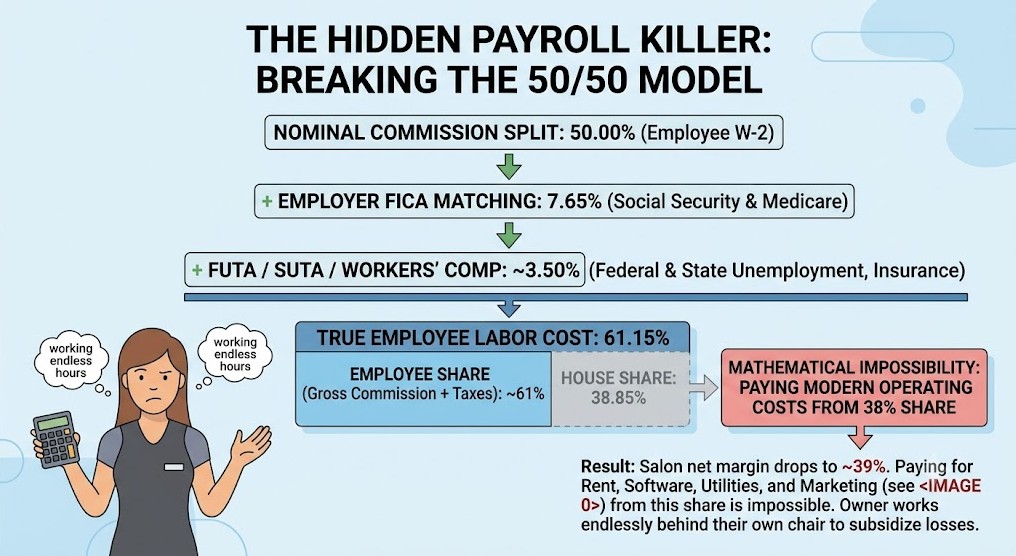
When a stylist executes a $100 service under a 50% split, you do not keep $50. Once the state and federal tax systems process the payroll transaction, your actual labor cost surges to roughly 60% or 61%. This means the house’s actual share drops to a thin 39% or 38%.
Attempting to pay for premium real estate, backbar developers, front-desk reception staff, and marketing out of a 38% share is a mathematical impossibility. This hidden payroll gap is the has owners finding themselves working endless hours behind their own chair just to subsidize the losses generated by their own staff.
To prevent the margin squeeze, you must stop guessing your pay metrics and learn how to calculate your true salon commission ceiling. This requires analyzing your profit and loss metrics through the lens of strict unit economics—breaking your large monthly overhead down into small, measurable costs per chair hour.
The first step is determining the exact operational cost of a single chair sitting on your floor for one hour. This is your baseline break-even metric. To find this number, you must calculate your Total Fixed Monthly Overhead (excluding all variable stylist commissions and retail inventory costs). This aggregate includes your rent, utilities, insurance, salon software tools, marketing budgets, and administrative or front-desk salaries.
Once you have your total monthly fixed overhead, use this simple operational formula to find your baseline break-even metric:
Chair Hourly Cost = Total Fixed Monthly Overhead ÷ (Number of Chairs × Total Operational Hours per Month)
Let’s look at a practical example of a 6-chair salon with a fixed monthly operational overhead of $9,000, open 200 hours per month:
This means that before a stylist even touches a client's hair, every single chair on your floor costs your business $7.50 every hour the doors are open, whether it is filled or empty.
If a stylist executes a $60 service in one hour, you must deduct that $7.50 fixed cost from the house’s share. If you are mistakenly paying a flat 50% split, the remaining cash left to the house-after backend taxes and fixed costs-vanishes entirely. This leaves you with zero capital to invest back into your business.
Knowing your exact hourly break-even cost gives you a clear financial baseline. This data allows you to engineer smart commission tiers that safely protect your salon's profit margins.
The second critical metric in calculating your commission ceiling is accounting for variable product consumption, commonly referred to as "backbar waste." High-ticket chemical services—such as complex balayages, keratin smoothing treatments, and advanced structural nail gels—consume significant amounts of expensive chemical inventory.
If you calculate a stylist's commission split on the total gross price of the service without accounting for this product cost, you are effectively paying your team a percentage bonus for the inventory your business purchased.
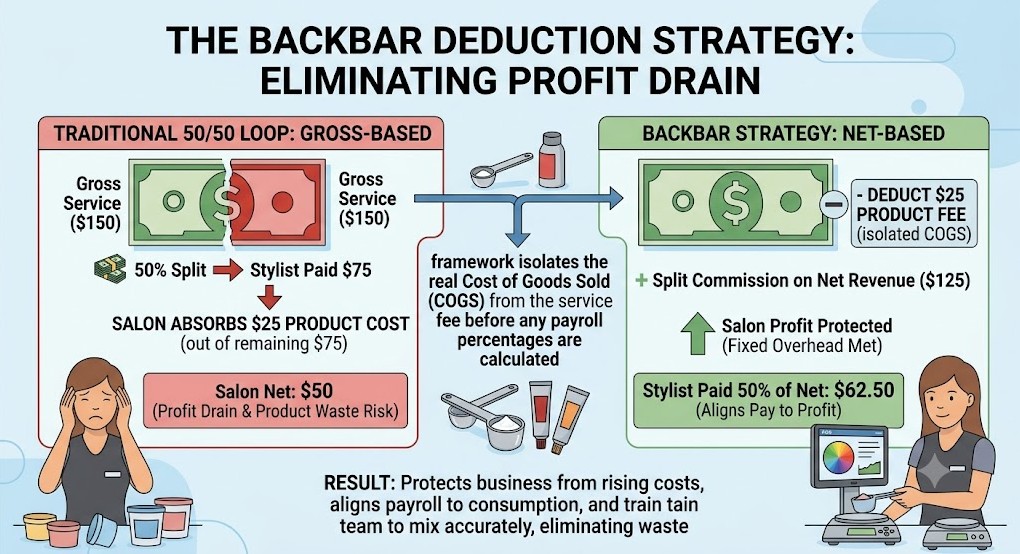
To eliminate this profit drain, modern, sustainable salons implement the Backbar Deduction Strategy. This framework isolates the real cost of goods sold (COGS) from the service fee before any payroll percentages are calculated.
For example, if a multi-step color correction is priced at $200, and the digital inventory log shows that exactly $30 worth of color tubes, lighteners, and developers were consumed, that $30 product fee is immediately deducted from the gross ticket. The remaining $170 of Net Revenue is the true baseline used to calculate the stylist’s commission split.
Implementing this strategy directly protects your business from rising wholesale distributor costs, aligns your payroll to actual consumption metrics, and trains your styling team to mix products accurately, eliminating expensive backbar waste across your entire floor.
To remain profitable, a salon must abandon flat, predictable pay systems that reward baseline attendance over active revenue generation. A fixed split structure offers no built-in financial agility; it treats a technician who barely covers their seat cost exactly the same as a high-velocity operator who packs their station back-to-back. To scale your business safely through 2026, your payroll must adapt dynamically to performance.
Modern high-profit compensation architecture shifts away from rigid splits and introduces performance-driven tiering. This structural alignment guarantees that your rising labor costs are always directly tied to an increase in your overall salon net profit margins.
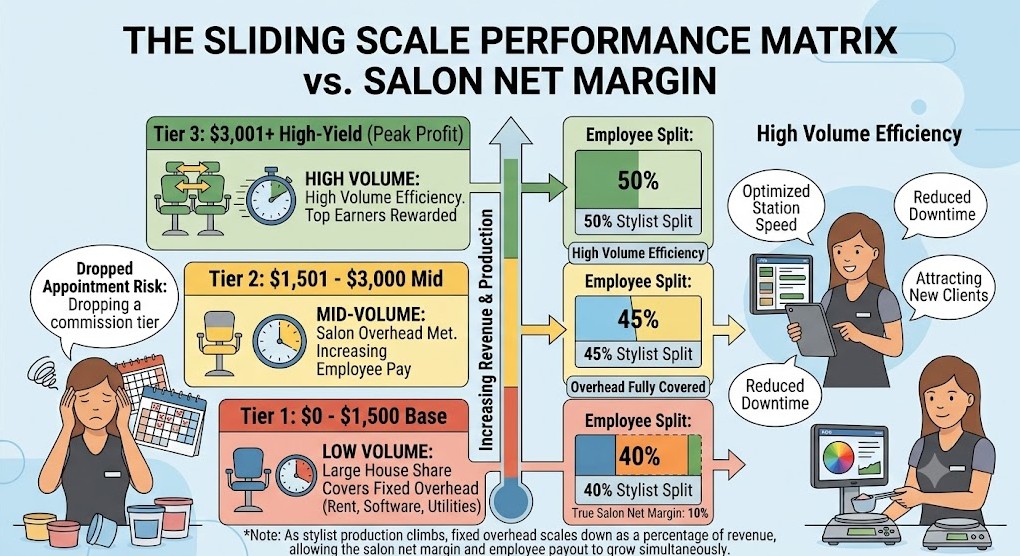
The Sliding Scale (or Progressive Model) is a dynamic compensation model built on a clear financial principle: a stylist’s commission percentage should rise only as their total gross production clears specific milestone tiers within a single billing period.
When a stylist operates at a lower volume (e.g., generating $1,000 a week), their chair hour utilization is low. Because of this, a larger percentage of their revenue should remain with the house to cover fixed operational overhead like rent and front-desk software. However, once that stylist’s weekly production scales past a higher threshold (e.g., $3,000 a week), your fixed salon overhead is already fully covered. Every dollar generated past that break-even milestone is high-margin profit, allowing the house to safely pass a higher commission split back to the stylist.
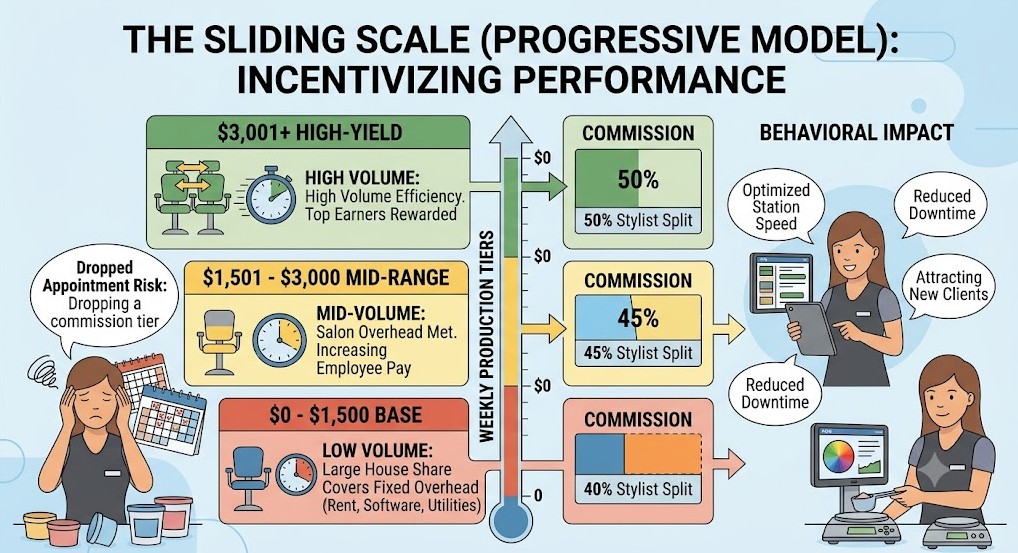
Using this progressive framework changes the behavioral culture of your salon floor. Your staff is less likely to treat their open schedule blocks with casual indifference. They realize that dropping a time slot or running late doesn't just cost them a single appointment—it risks dropping their entire weekly performance into a lower commission tier.
This model can filter out low-productivity habits and incentivizes your team to optimize station speed, reduce transition downtime, and actively pull fresh client volume into their chairs.
An alternative modern model designed for highly collaborative salon brands is the Team-Based Pay Structure. Traditional commission models can inadvertently breed an aggressive, territorial environment where individual stylists isolate themselves, guard their client formulas, and view neighboring colleagues as direct competition for floor walk-ins. This individual-first ego hurts your overall Seat Utilization Rate.
Team-Based Pay removes individual service tracking entirely and shifts compensation to a stable, premium hourly wage paired with a unified, salon-wide performance bonus. In this operational model, the entire team is measured against the total capacity of the salon footprint.
When the business clears its global monthly revenue goal through shared client handling, cross-station assistance, and seamless front-desk checkouts, an executive bonus pool is unlocked and distributed proportionally across the entire staff. This structure removes the internal friction of chair assignment, encourages master stylists to mentor junior assistants, and ensures that your entire floor operates like a highly synchronized team focused on maximizing your overall brand revenue per square foot.
A common error made by salon owners when creating a pay structure is bundling service payouts and retail product sales into a single commission metric. Retail inventory operates on very different economic margins than technical services.
While a haircut or a gel refresh is primarily driven by billable labor time, a bottle of premium shampoo, styling pomade, or cuticle oil carries a direct, fixed wholesale purchasing cost from an outside distributor. If you mistakenly pay out the same high commission percentage on retail sales as you do on your service menu, your retail program will quickly turn from a revenue driver into a severe financial deficit.
To protect your inventory margins, you must completely separate your service splits from your retail compensation. Retail sales should be managed via a distinct, tiered incentive structure that rewards stylists for volume without eating into the house’s product margins.
The baseline retail commission should sit between 10% and 15% of the gross product sale price—never matching the high 45% or 50% levels of your service splits.
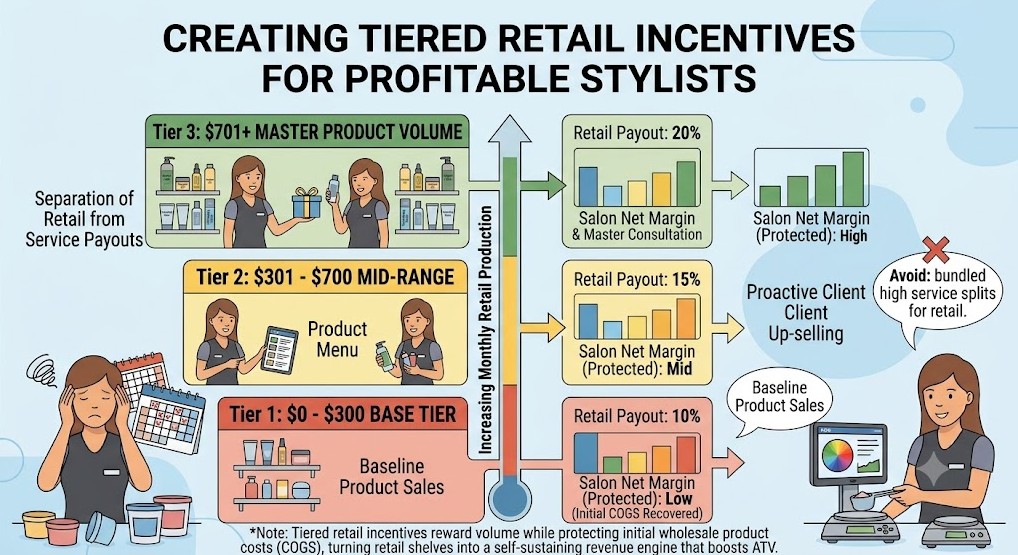
To transform your creative staff into active, profitable retail consultants, implement tiered monthly product goals. When a stylist crosses a threshold (such as selling more than $700 worth of retail products in a single month), their retail payout percentage climbs.
This separation ensures that your business safely recovers its initial wholesale product acquisition costs first. It turns your retail shelves into a highly profitable, self-sustaining revenue engine that boosts your overall average ticket value (ATV) without draining your core service cash flow.
The absolute peak of retail engineering is automating the prescription of aftercare packages directly within the service checkout process. Stylists frequently struggle with direct sales; they often feel uncomfortable or pushy when pitching retail bottles over the counter at the end of an appointment.
To overcome this behavioral barrier, high-yield salons use their point-of-sale systems to bundle professional home care packages directly into their premium service packages.
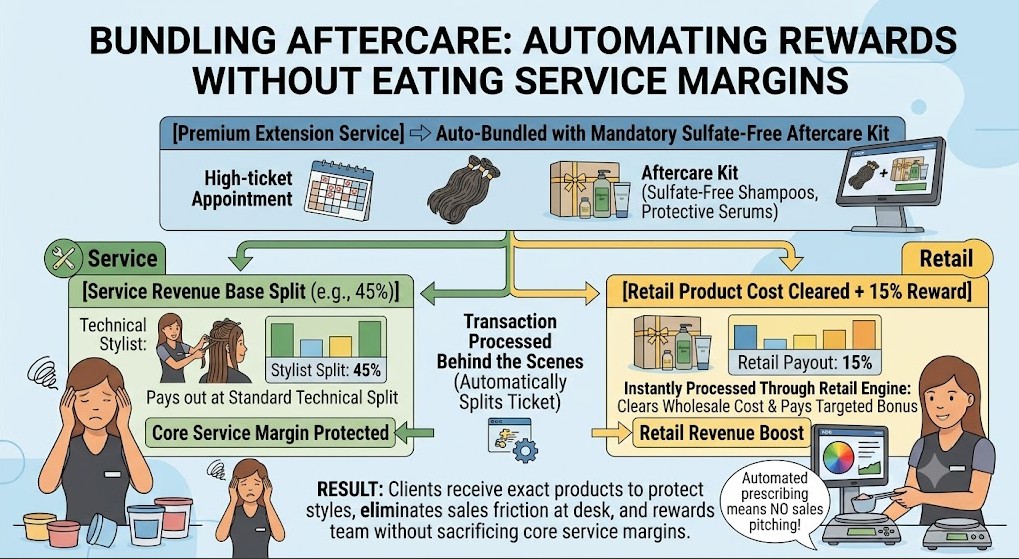
For example, when a client books a high-ticket service like a complex keratin smoothing treatment or premium hair extensions, the service is automatically bundled with a required home aftercare kit (containing specific sulfate-free shampoos and protective serums).
When the transaction is processed at the front desk, your management software automatically splits the ticket behind the scenes. The service portion pays out at the stylist's standard technical split, while the aftercare kit is instantly processed through your retail engine—clearing the product’s wholesale cost and paying the stylist a targeted retail bonus.
Automating this process ensures your clients receive the exact products needed to protect their styles, eliminates sales friction at the desk, and rewards your team without sacrificing your core service profit margins.
Chaging an established compensation model is a high-stakes operational change. Money is deeply tied to emotional security and professional worth. If your team perceives a structural pay shift as a hidden pay cut designed to squeeze their labor, you risk triggering an immediate operational mutiny.
Mismanaged payroll transformations can lead to sudden staff departures, damage your salon's reputation in the local community, and cause a sudden drop in client retention as stylists take their loyal guests with them. To restructure your payroll successfully, you must approach the change with absolute transparency, clear strategic messaging, and firm legal boundaries.
The primary mistake owners make when introducing a new sliding-scale or backbar-deduction model is pitching the change from an owner-centric viewpoint. If you present the adjustment by focusing on your rising rent, your thin margins, or the salon’s financial deficits, your staff will instinctively push back. They will view the change as an unfair attempt to force them to subsidize your overhead challenges.
Instead, frame the transition by focusing on mutual growth, career advancement, and long-term business stability:
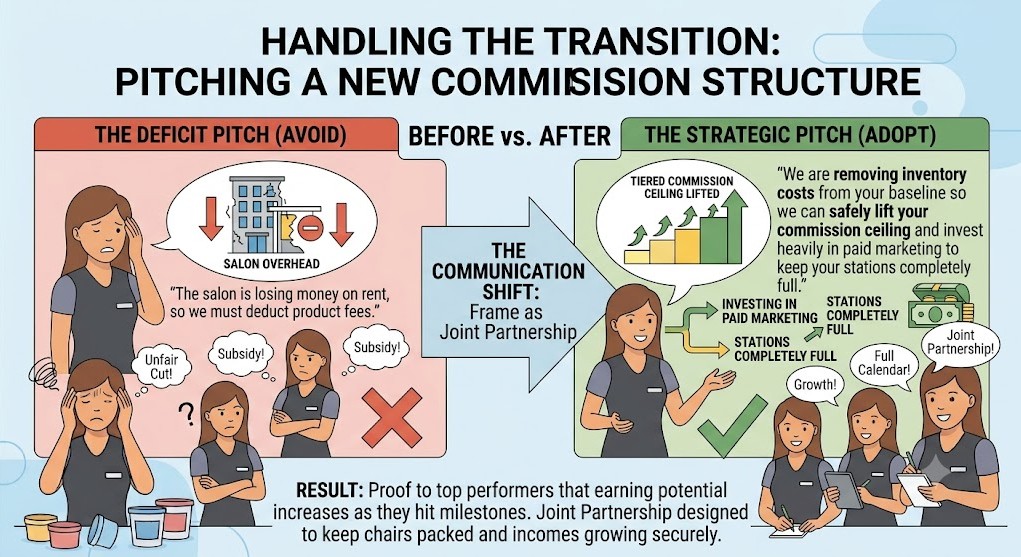
When rolling out the new structure, hold an open, data-driven team meeting. Show the team exactly how the flat 50/50 model limits the business's ability to fund high-converting local ad campaigns and premium guest amenities. Explain that by isolating backbar deductions and establishing clear production tiers, you are building an agile framework that directly rewards high-velocity performance.
Prove to your top performers that under the new progressive sliding scale, their earning potential actually increases as they hit higher production milestones. Frame the change not as an operational restriction, but as a joint business partnership designed to keep their chairs packed and their incomes growing securely.
While a sliding-scale structure naturally rewards high-volume operators, your top-producing stylists—those who consistently run at a 90% seat capacity and generate massive retail volume—are always targeted by competitors offering cheap booth-rental spaces. To protect your team retention, you must build premium, legally compliant performance rewards into your corporate structure that a basic booth-rental setup cannot match.
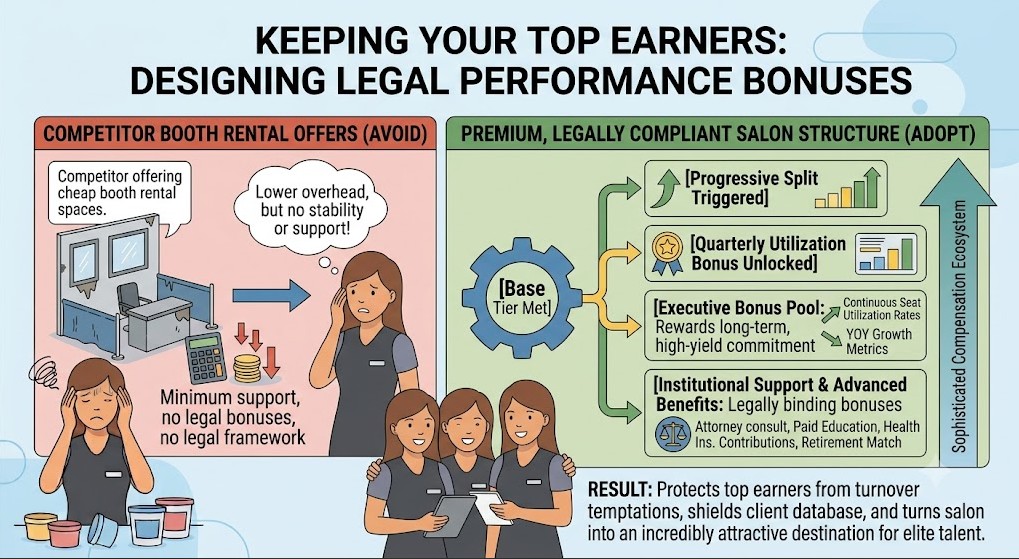
Design an executive bonus pool that rewards long-term, high-yield commitment to the brand. For example, introduce a quarterly retention bonus linked to continuous Seat Utilization Rates and year-over-year growth metrics.
Work closely with an experienced employment attorney to structure these rewards as legally binding performance bonuses within your standard W-2 framework. Offering advanced benefits—such as paid educational allowances, structured health insurance contributions, or performance-backed retirement matches—creates a sophisticated compensation ecosystem. This institutional support protects your top earners from turnover temptations, shields your client database, and turns your salon into an incredibly attractive destination for elite styling talent.
Transitioning away from flat splits and introducing variable sliding scales, precise product deductions, and split retail reward programs introduces a major operational challenge: administrative complexity. Tracking these data points manually using paper logs or basic spreadsheets will turn your weekend into a nightmare of tedious bookkeeping and accounting errors.
To scale your salon business safely without drowning in paperwork, completely automate your payroll workflows using a powerful, enterprise-grade cloud management system.
A modern salon workflow requires a point-of-sale (POS) engine that processes complex compensation rules instantly at the moment of client checkout. When a receptionist processes a client for a multi-step service tier, your software should handle the financial breakdown automatically behind the scenes:
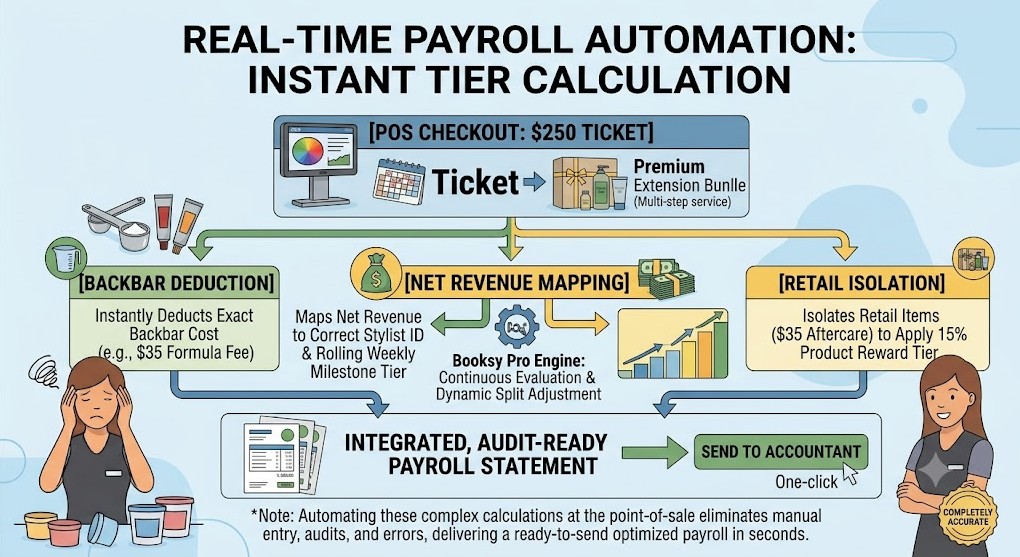
Using an advanced system like Booksy Biz eliminates manual double-entry. The system continuously evaluates each employee’s rolling weekly or bi-weekly production metrics, dynamically adjusting their commission split as they cross into higher progressive tiers.
At the end of your billing cycle, instead of spending hours auditing receipts and cross-referencing product usage, you simply pull up a centralized report. The system delivers an integrated, audit-ready payroll statement that is completely accurate, fully optimized, and ready to send to your accountant with a single click.
True managerial control is built on continuous, real-time data visibility. Advanced salon platforms replace retrospective accounting with live analytics dashboards that display the exact financial productivity of every single chair on your floor.
Through dedicated staff portal, both you and your service providers gain access to real-time performance analytics:
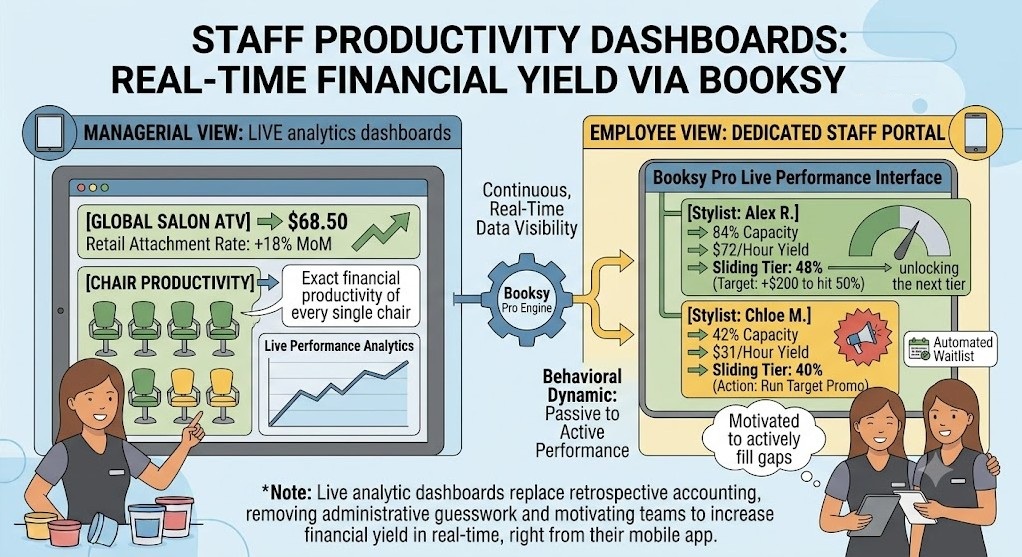
Tracking your team’s Financial Yield Per Hour changes the behavioral dynamic of your floor. Barbers and stylists no longer wait around passively until the end of the month to evaluate their performance. They can see exactly how close they are to unlocking the next sliding-scale percentage tier right from their mobile app.
This transparency removes administrative guesswork, motivates your team to actively fill gaps in their calendars using automated waitlists, and provides you with the precise data insights needed to run a highly profitable, self-sustaining enterprise.
Transitioning your salon away from traditional flat splits is a critical evolution that separates creative service providers from data-driven business operators. Craftsmanship, beautiful space design, and great hospitality are the soul of your brand, but balanced, precise financial engineering is the spine that keeps your business standing.
The traditional 50/50 commission model is fundamentally broken in today's high-overhead economic climate. By calculating your exact break-even cost per chair hour, implementing clear backbar deduction guards, and deploying progressive sliding scales, you protect your business from insolvency while aligning your labor costs directly with actual top-line production.
Do not let your hard-earned business margins disappear through an unengineered, outdated compensation plan. Protect your business capital, back your team payroll with a professional cloud-based platform like Booksy, and build a high-performance salon engineered for maximum profitability, elite staff retention, and true long-term financial freedom.