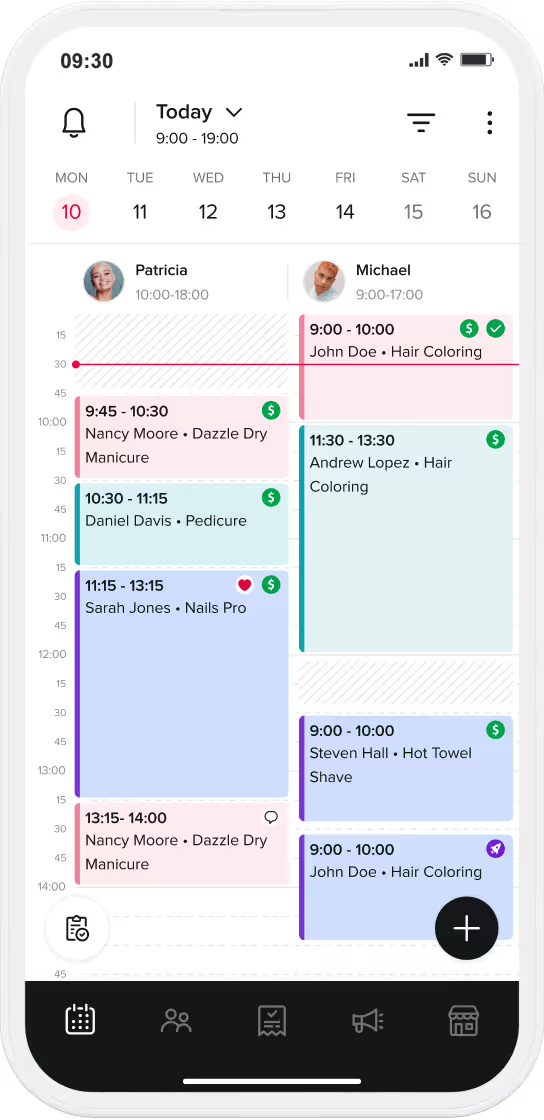
In a highly competitive industry, the difference between healthy margins and an unprofitable business can come down to minutes. For nail salon owners, managing a daily schedule is a masterclass in calendar synchronization. Services like gel extensions, intricate structural builder gels, and multi-tier nail art require deep technical precision and absolute time discipline. Despite meticulous planning, late-arriving clients cause disruption to salon operations.
Protecting your schedule from late arrivals does not require you to sacrifice the warm, hospitable culture that drives client retention. But it does ask you to transition from casual, reactive scheduling to proactive time engineering. This guide provides an operational framework and communication scripting needed to build a defense against late arrivals. Automating your policies and communicating firm boundaries can eliminate calendar chaos and maximize the profit potential of every station in your salon.
In a traditional nail salon layout, appointments are booked back-to-back with minimal padding. A technician’s schedule is optimized to keep seats full. While this tight spacing is essential for driving daily volume, it means your calendar allows for no margin of error. One late arrival in the morning is a wrench in a high-speed machine. The delay rolls forward into the afternoon, creating a cascading bottleneck.
When a technician attempts to accommodate a late client without shifting the following appointments, they create a "service compression” by squeezing a multi-step service into a shortened time block. In nail styling, rushing through critical preparation steps—such as e-file cuticle work, dehydration, and priming—is a recipe for technical failure. Rushing leads to poor adhesion, lifting, and premature breakage, which inevitably results in costly, unbillable repair appointments later in the week.
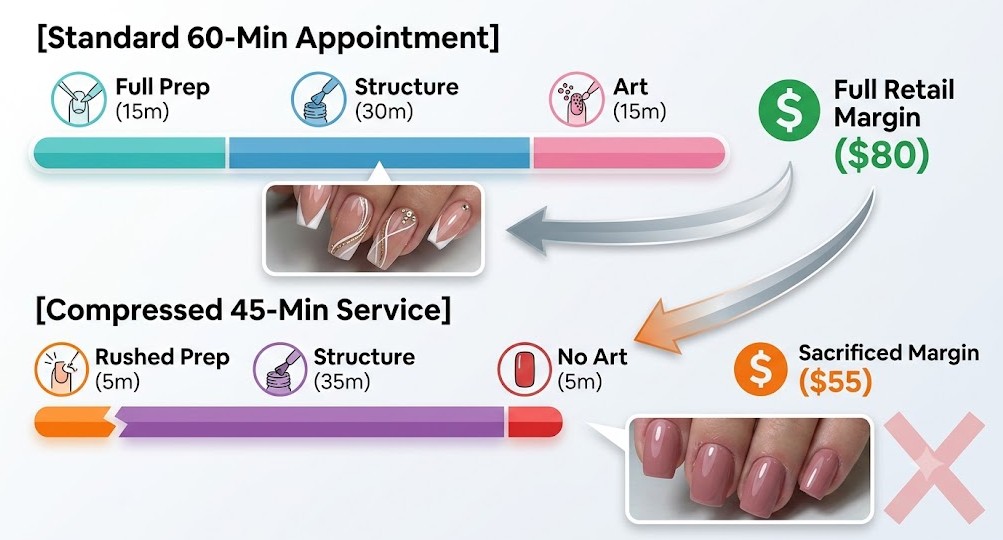
More importantly, service compression forces the technician to strip away the high-margin add-ons. If a client is 15 minutes late for a full set with nail art, the technician cannot magically speed up the curing time of the UV lamp. To finish on time for the next guest, the artist must cut out the nail art tier and perform a basic single-color instead.
Your average ticket value (ATV) drops instantly. You end up burning the exact same amount of overhead, labor, and station time, but you lose the high-profit premium revenue.
The damage caused by accommodating a late client extends beyond financial loss; it creates friction within your human resources. When a nail technician is forced to work faster to catch up, their stress levels skyrocket. They lose the moment to wash their hands, sanitize their bits, or grab a drink of water between appointments. A constant, high-pressure environment leads directly to physical fatigue and long-term staff burnout, which drives up employee turnover rates in an industry already struggling with talent retention.
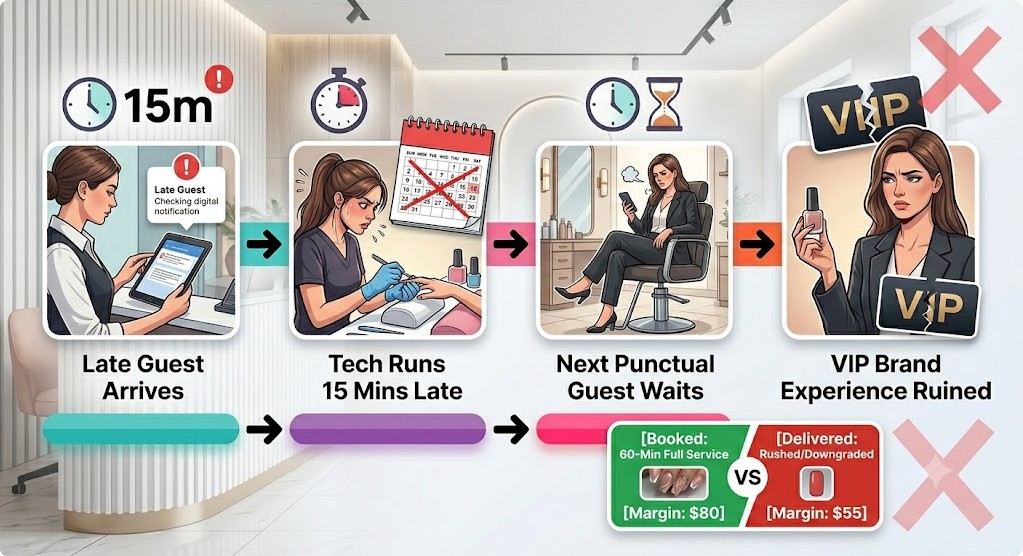
This stress is directly passed on to your punctual, reliable VIP clients. The next client—who arrived on time—is forced to sit in the waiting area for 15 to 20 minutes past their scheduled start time, breaking your brand promise. You are effectively punishing your best, most disciplined customers to accommodate the poor habits of a late offender. This erosion of client trust destroys the guest experience, lowers your Google Review ratings, and drives your highest-spending clients to competitors who respect their time.
To eliminate the chaos of schedule drift, a nail salon must stop relying on the decisions of individual receptionists or technicians. Under high-pressure situations, staff members will naturally default to avoiding confrontation, often choosing to accept a late client even when it breaks the afternoon schedule. To protect your business, you must hardcode a clear framework that takes emotion from the equation and establishes automated, standardized rules for everyone.
The foundation of an effective scheduling policy is a clear, non-negotiable cut-off point. The industry-recognized standard for high-volume nail salons is the 10-Minute Grace Period. This rule establishes that while a salon understands that traffic or minor delays occur, a desk cannot remain open past the 10-minute mark without compromising the integrity of the business model.
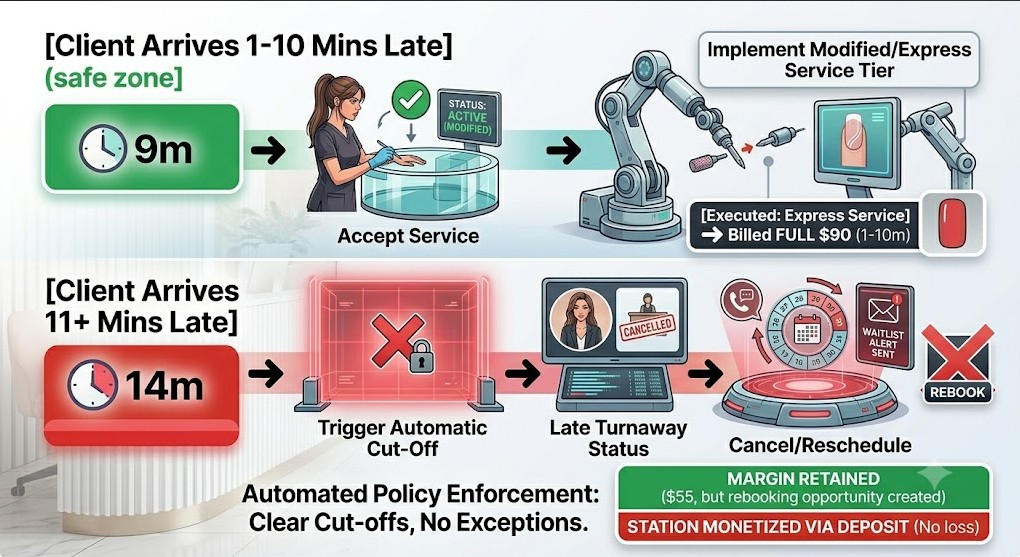
Once a client passes the 10-minute threshold, your software engine must automatically flag the appointment status as a "Late Turnaway." This hard cut-off must be absolute. If a client arrives 12 minutes late for a 45-minute gel manicure, they have burned nearly 30% of their billable time block.
By standardizing this executive cut-off point across your entire staff, you end inconsistency. Clients learn that your time boundaries are fixed, which naturally affects their behavior and helps them to prioritize punctuality when booking with your brand.
A late-arrival policy is only enforceable if it is fully transparent and communicated long before the client ever leaves their house. To remove any legal or operational arguments at the front desk, your late-arrival guidelines must be integrated into every single digital and physical touchpoint of the client journey:
Even with your policies explicitly stated across every digital channel, the true test of your salon’s time discipline happens at the front desk. When a client walks through your doors 12 minutes late, defensive scheduling moves from theory to real-time boundary enforcement.
This moment of confrontation are challenging because beauty professionals are naturally trained to be hospitable and accommodating. It’s likely your staff will could cave to pressure, wave the client through to the chair, and completely destroy the afternoon schedule. To prevent this, you must arm your technicians and front-desk team with clear service modification rules and assertive, professional scripting.
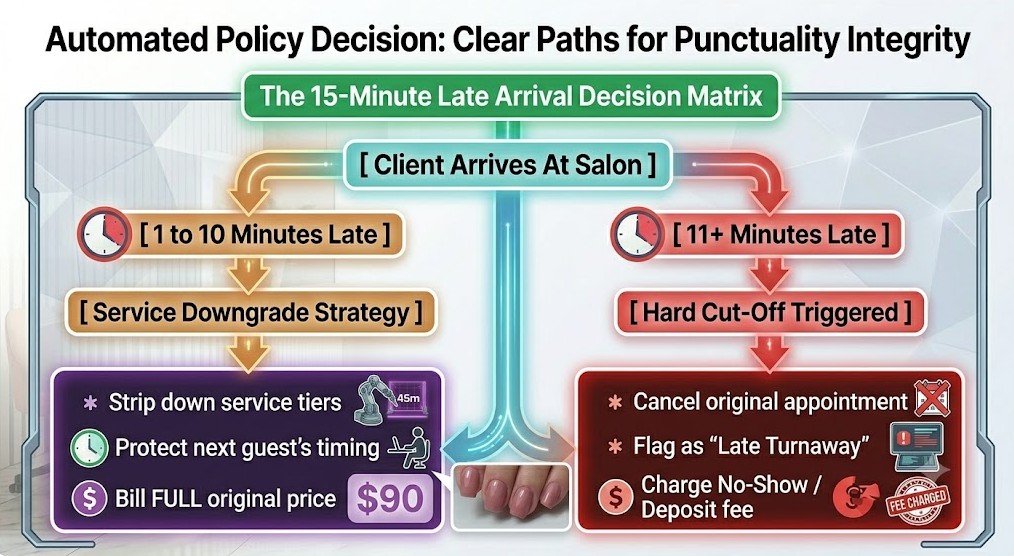
If a client arrives near the absolute limit of your grace period—for example, exactly 9 or 10 minutes late—they have technically bypassed your hard cut-off. However, they have still severely compromised their booked time block. If you allow them to proceed with their original high-level booking, your technician is forced into highly stressful service compression, risking poor execution and an overrunning schedule.
The solution to this operational bottleneck is the Service Downgrade Strategy. This rule dictates that if a client is late but falls within the acceptable grace period window, they may still occupy the chair, but their service tier is instantly stripped down to fit the remaining time—while they are still billed the full price of the originally booked appointment.
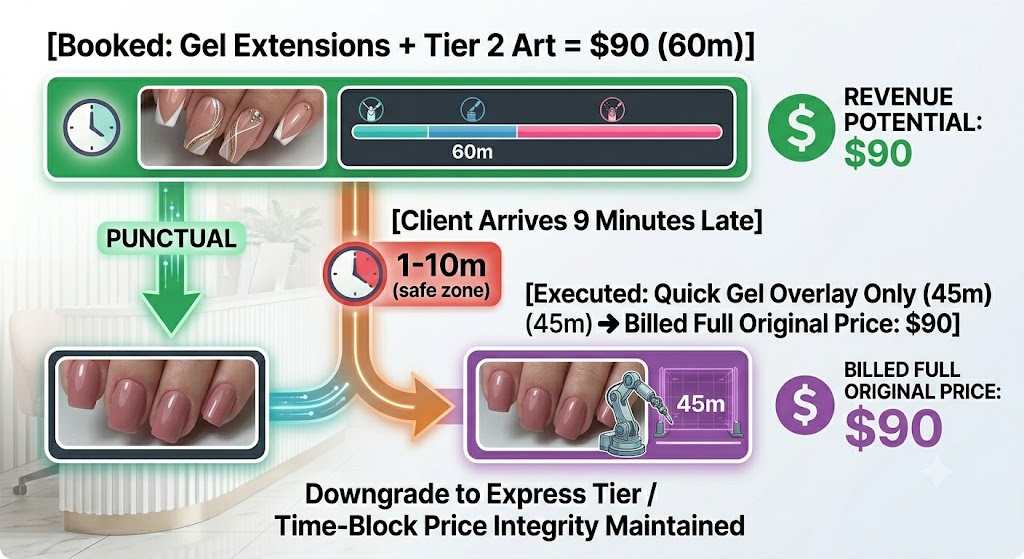
For example, if a client booked a full structured gel set with custom nail art but arrives late, the technician politely informs them that they only have time to execute a clean, single-color builder gel overlay. The custom nail art is removed from the schedule to protect the next guest's start time, but the client is billed the full original price.
This is not a punitive measure; it is a direct financial reflection of seat leasing.
Enforcing a downgrade or a complete late turnaway requires absolute emotional neutrality. If your staff feels uncomfortable or aggressive, the situation will quickly ruin the calm atmosphere of your salon floor.
Your team must be trained to shift the blame away from personal judgment and place it entirely on your automated system logistics.
Script 1: For a Service Downgrade (Within the Grace Period)
"Hi [Client Name], we’re so glad you made it safely! Because we are running exactly 9 minutes into your 45-minute window, our booking system automatically recalculates the available technical time to ensure our next guest starts exactly on schedule. Today, we will focus on an executive single-color gel refresh to guarantee a flawless, high-precision finish without rushing your cuticle prep. We’ll still honor the booked station slot price today, and we can lock in your detailed custom nail art for your next visit!"
"Hi [Client Name], I completely understand that traffic was an absolute nightmare today. However, because we are 13 minutes into your appointment block, our digital calendar has automatically marked this slot as a late turnaway to protect the schedules of the clients booked directly after you. Our systems require full-length blocks to guarantee our structural gel adhesion standards. Let’s jump into the digital waitlist right now to see if we can slide you into a flash opening later this afternoon, or secure a priority slot for next Tuesday morning."
While handling confrontations at the front desk is necessary, the most profitable strategy is to completely eliminate lateness before it ever occurs. High-yield nail salons do not wait around hoping clients will arrive on time; they use automated, data-driven systems to actively manage client behavior long before the appointment window opens.
Many salons make the mistake of sending a single, generic appointment reminder 24 hours before a service. In a busy digital economy, a single email is easily buried, ignored, or forgotten. To drastically reduce late arrivals, you must deploy a multi-channel automated communication matrix that sends tailored messages through text, email, and mobile push notifications at critical psychological intervals.
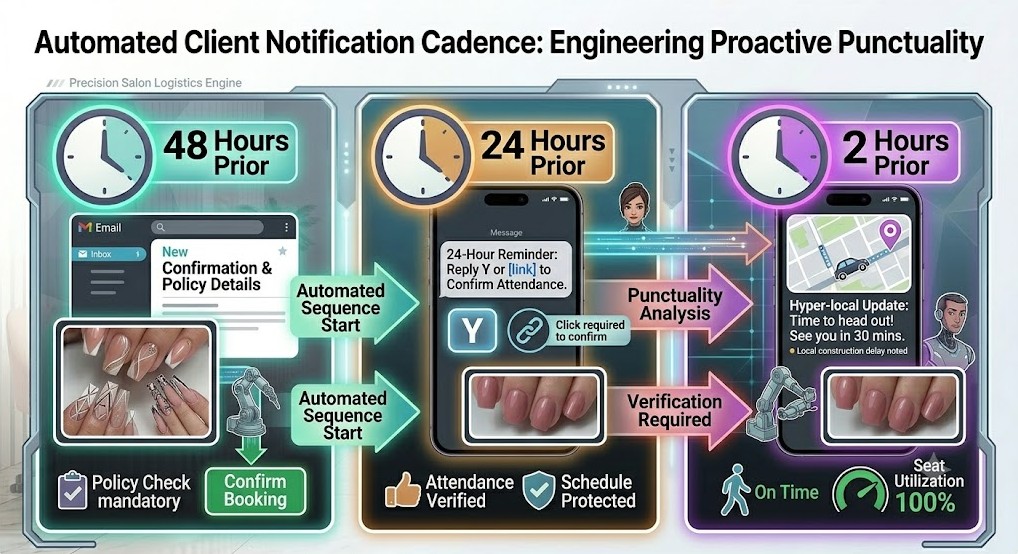
Your communication sequence should scale up in urgency as the appointment draws closer:
Every nail salon has a segment of clients who are chronically, predictably late. No matter how many text messages, push alerts, or phone calls they receive, they will consistently arrive 10 to 12 minutes past their scheduled start time. While your long-term goal is to modify their behavior using your late fee policies, you can use Predictive Late Booking data to protect your immediate floor logistics.
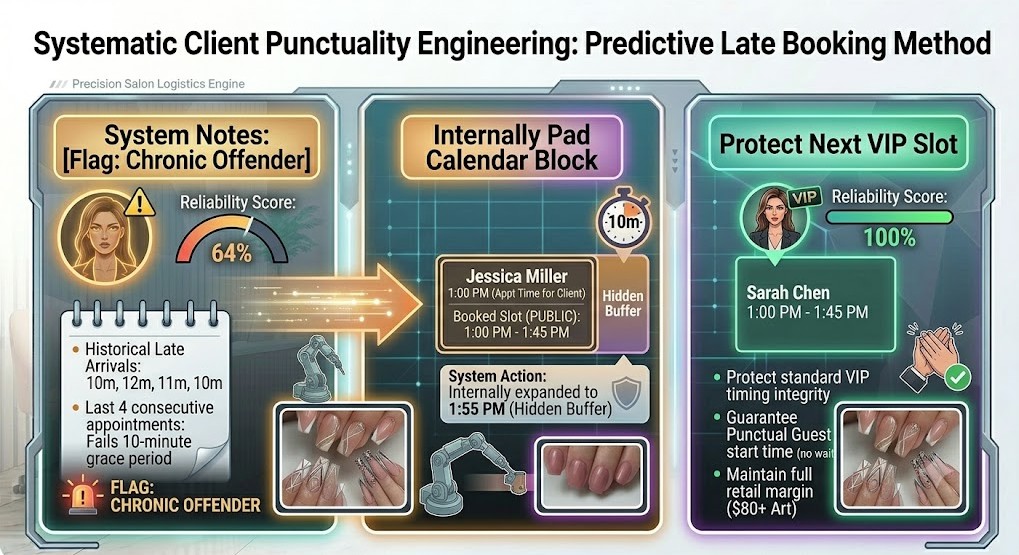
Advanced shop management software allows you to leave permanent, internal operational notes inside specific client profiles. If your team data reveals that a particular guest has run late for their last four consecutive appointments, the system flags them.
When that client books an appointment online, your front-desk team or software engine can internally expand their calendar block by 10 minutes on the backend—without changing the public arrival time shown to the client. If they book a 1:00 PM manicure, the client sees a strict 1:00 PM start time, but your internal calendar blocks the station out until 1:55 PM instead of 1:45 PM.
This hidden buffer functions as an operational shock absorber. When the client inevitably arrives late, they consume their own custom internal buffer rather than bleeding into the next innocent guest's time slot. This data-driven approach keeps your entire salon floor running with absolute smoothness and predictability.
Even the most perfectly optimized notification sequence and de-escalation training cannot completely stop the financial impact of a client who simply fails to show up on time. In a business model built on razor-thin time blocks, relying on empty promises to protect your schedule is a major financial risk. To build a highly profitable salon, you must move away from honor-system booking and implement automated financial guards.
Adding immediate financial accountability to every reservation protects your cash flow and ensures that an empty station chair is still a monetized asset.
The most effective way to eliminate casual lateness and sudden cancellations is the implementation of upfront, non-refundable booking deposits. When a client can book a 90-minute full set of extensions without any financial commitment, they feel zero skin in the game. If they wake up late, run behind schedule, or change their plans, they face no immediate consequence for leaving your chair empty.
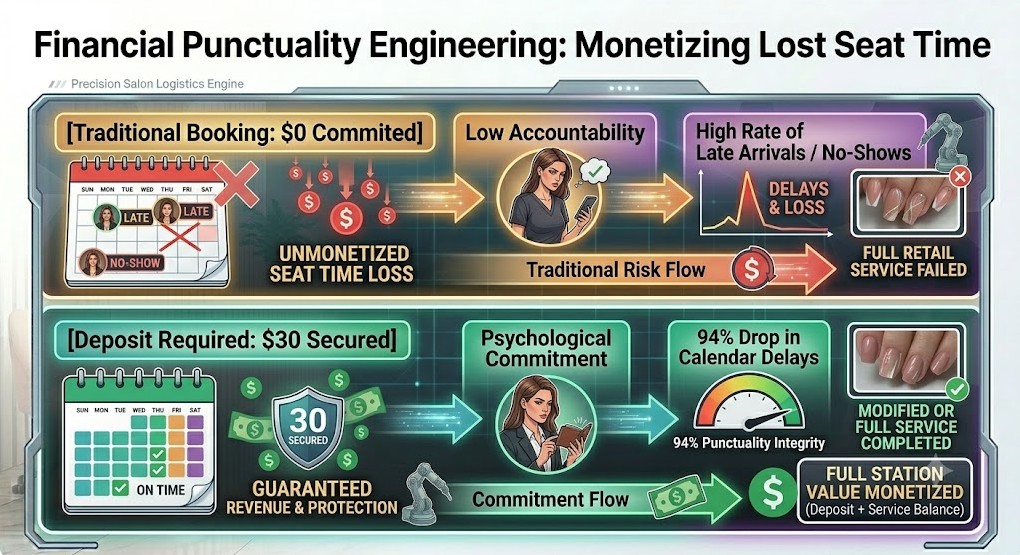
Requiring a non-refundable deposit (such as 25% or 50% of the service fee) during the online checkout changes the client’s psychology. The moment money leaves their account, the appointment transitions from a casual option into a locked-in financial asset.
Clients will actively plan their travel routes, account for morning traffic, and leave their homes earlier to avoid losing that deposit. If a client still violates your 10-minute grace period and triggers a late turnaway, that deposit stays in your account. This ensures that your nail technician is still compensated for their blocked time, your backbar overhead is covered, and your lost seat time is fully monetized.
For premium nail salons where upfront deposits might not match your specific brand positioning, Card-on-File (No-Show Protection) serves as an equally powerful financial shield. This allows clients to book without paying immediately, but requires them to securely save a valid credit card within your encrypted scheduling vault to finalize the reservation.
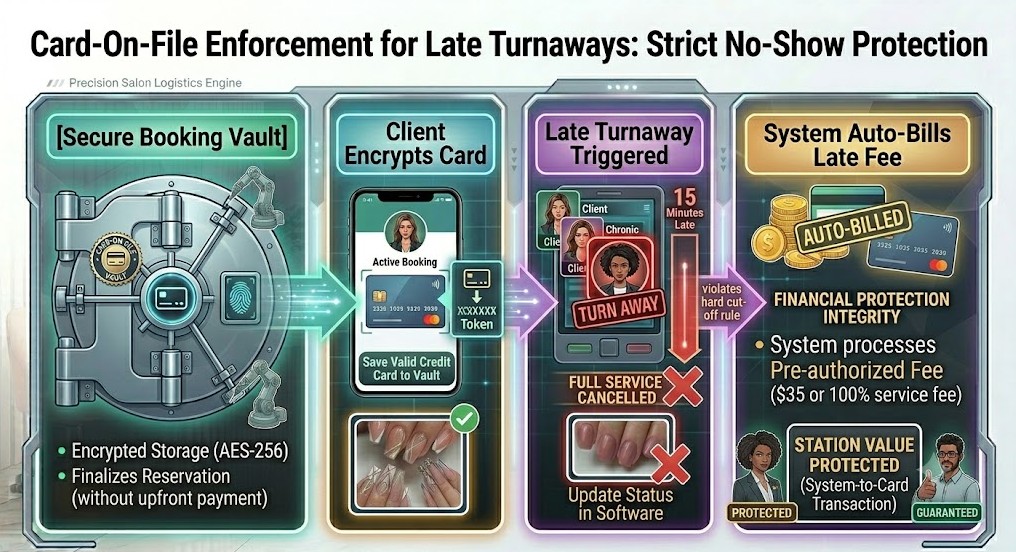
If a guest arrives 15 minutes late and violates your hard cut-off rule, your front-desk staff can enforce your policy with absolute financial backing. When the appointment is updated to "Late Turnaway" status, your software engine automatically processes a pre-authorized late cancellation fee (e.g., $35 or 100% of the service fee) directly to the card on file.
Automation removes the awkward, high-stress confrontation of demanding payment over the counter from an upset client. It guarantees that your salon is financially protected against schedule disruptions, regardless of personal excuses.
The final phase of time engineering is moving away from reactive boundary enforcement and using predictive data analytics. Your scheduling software should function as an intelligent analytics engine. Every check-in, late arrival, and missed appointment generates a digital data footprint. By aggregating this operational data, you can flag scheduling risks before they damage your floor logistics.
High-performing salons use advanced digital client profiles that track a live Client Reliability Score (or booking attendance rate). Every time a user reserves an appointment, the system automatically calculates their historical punctuality. If a client has booked 10 appointments and arrived exactly on time for all of them, they retain a perfect 100% Reliability Score. If they frequently violate your grace period, their profile rating drops.
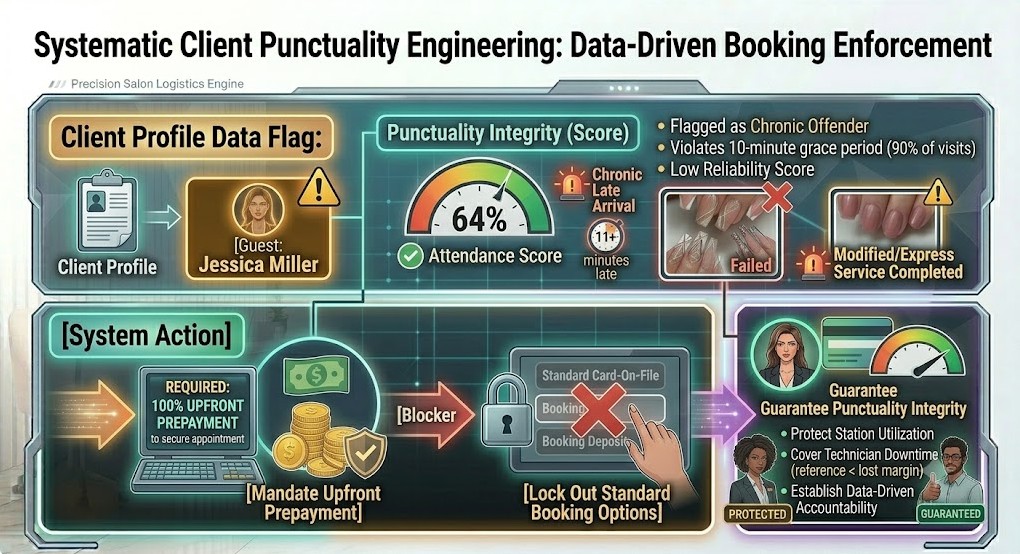
When a chronic late offender with a low reliability score attempts to book a high-value service online, your system can automatically deploy targeted booking guards. The software can block them from standard card-on-file options and mandate a 100% upfront prepayment to secure the slot.
Alternatively, it can automatically restrict them to low-traffic, mid-week time slots where a minor delay won't disrupt your prime weekend revenue rush. Using data to identify high-risk bookings allows you to protect your technicians from chronic disrupters and keep your floor running smoothly.
When a late arrival passes the 10-minute mark and is turned away, your primary focus shifts from enforcing rules to immediate revenue recovery. A late turnaway leaves an unexpected, blank gap in your calendar. If that station stays empty for the next 45 minutes, your seat utilization rate drops. To prevent this loss, your platform must feature a real-time, automated waitlist recovery engine.
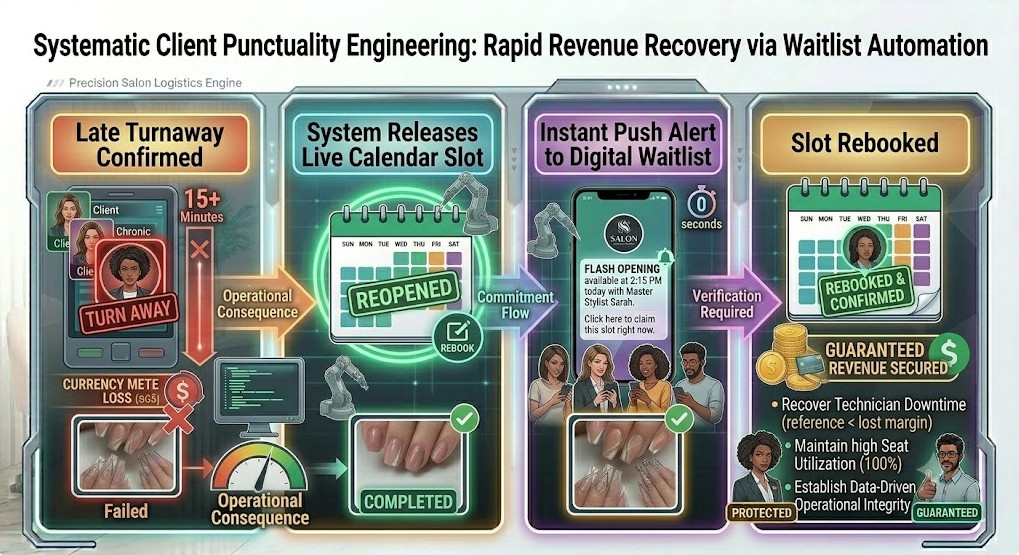
The moment your front desk marks an appointment as a late turnaway, your system releases that time slot back into the digital market. The software instantly checks your local waitlist—a queue of clients who have explicitly requested to be notified if a sudden opening appears that day.
The engine sends a fast push notification or SMS alert to those waiting clients: "A flash opening just became available at 2:15 PM today with Master Stylist Sarah. Click here to claim this slot right now." This automated recovery process fills unexpected scheduling gaps within minutes, allowing your salon to maintain a high seat utilization rate and protect your daily profit goals.
Building a highly profitable, scalable nail salon requires looking past the visual elements of your business and mastering your daily floor logistics. Intricate nail art techniques, beautiful interior design, and premium product lines are essential for drawing in customers, but strict time engineering is the foundation that keeps your business financially secure.
By hardcoding a strict 10-minute grace period, implementing service downgrade models that protect your average ticket value, and securing your calendar with automated deposits and card-on-file guards, you remove the chaos from your business.
Transition from a reactive manager to a data-driven business owner. Back your salon floor with a professional nail salon software platform like Booksy, set firm, professional boundaries, and build a high-performance beauty brand designed for maximum efficiency, long-term staff loyalty, and clear financial freedom.