For ambitious salon owners, expanding from a single thriving location to a multi-branch footprint is a milestone of business maturity. It represents the transition from being a localized service provider to operating a scalable corporate brand. However, many entrepreneurs discover that opening a second or third location is not a linear equation. What worked seamlessly for one storefront often collapses under the logistical strain of multi-site operations.
The reality of scaling in the modern beauty and wellness economy is brutal: expanding your footprint without unifying your technology and management protocols does not double your profits—it quadruples your operational stress. Scaling a salon brand requires moving past hands-on, intuitive management and embracing engineering precision. This guide serves as your strategic operational blueprint to expanding your physical presence while protecting your margins, standardizing your guest experience, and maintaining flawless control from a single command center.
Opening a second location is more than simply replicating the physical layout and hiring a new set of hands. When you operate a single location, management is organic. You are physically present to correct technical mistakes, audit the front desk, gauge team morale, and enforce cleanliness standards. Your personal oversight is the mortar holding the business together.
The moment you sign a second commercial lease, your physical presence is cut by 50%. You can’t be in two places simultaneously, and any underlying structural cracks in your business model that were masked by your personal hard work will fracture under the weight of physical distance.
Without your direct, daily presence, the invisible thread that holds your team together can fray. Left to their own devices, separate locations naturally develop distinct, isolated cultures, sometimes resulting in an "us versus them" competitive animosity between branches. This cultural drift quickly manifests as operational drift.
If your Standard Operating Procedures (SOPs) are not hardcoded into a digital framework, different locations will begin executing services differently. One branch might strictly enforce a 10-minute grace period for late arrivals, while the other consistently allows late clients to disrupt the entire daily schedule. One location might use precision scales to measure chemical backbar products, while the other relies on guesswork, rapidly inflating your cost of goods sold (COGS). Operational fragmentation erodes the integrity of your brand. A client visiting your downtown branch should receive the exact same service velocity, technical precision, and consultation quality as they would at your suburban outpost. If the consumer experience fluctuates based on geography, you do not own a multi-location brand; you own a collection of disconnected businesses sharing a logo.
The second phase of the scaling trap is the loss of real-time financial visibility. In a single-location setup, tracking daily revenue, retail performance, and labor costs can be managed via close observation. But when operations are split across multiple zip codes, monitoring the pulse of your business becomes incredibly complex without centralized analytics.
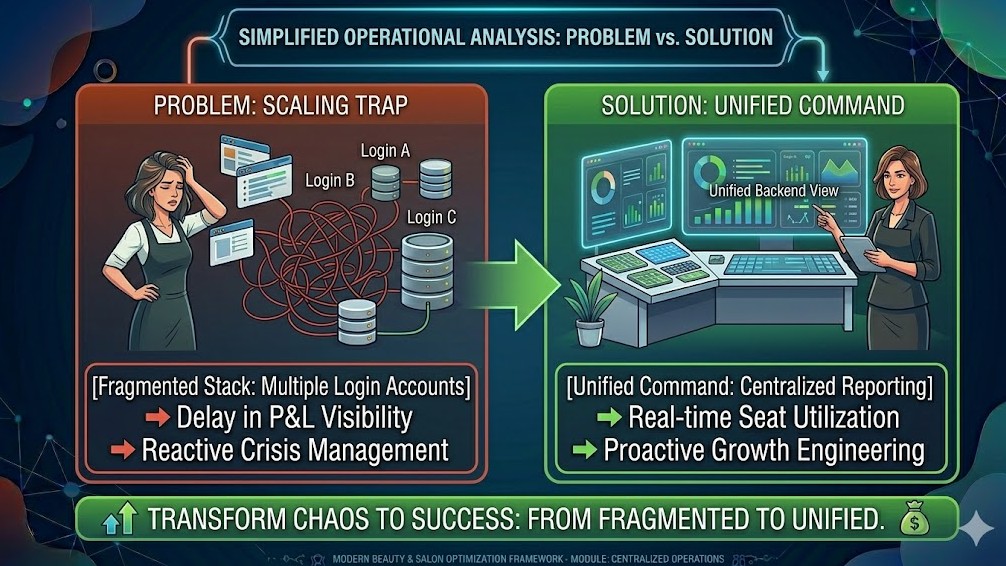
If your managers are using separate software accounts, running distinct point-of-sale (POS) batching systems, or keeping manual spreadsheets, you create an information vacuum. Profit leaks become invisible. An over-allocation of labor at Location A might go unnoticed because Location B had a record-breaking retail week, masking the structural deficit on an aggregated monthly level. When you operate with fragmented data reporting, you are constantly reacting to financial issues weeks after they occur. To scale sustainably, you require a single unified digital backend that streams live data from every chair across all regions into a consolidated executive dashboard.
Before expanding your physical footprint, you must define your operational governance model. How much operational autonomy will you grant to your individual location managers, and how much authority will remain concentrated at the executive level? Both paths have distinct structural trade-offs, and your choice determines how your technology stack will be configured.
The Corporate Control Model is built on complete operational uniformity. In this framework, individual branch managers do not make independent strategic choices. The corporate office controls all high-leverage business elements: your uniform service menu pricing, mandatory product distribution lines, marketing campaigns, cancellation policies, and staff commission tiers.
Conversely, the Autonomous Hub Model treats each salon branch as an independent economic engine tailored to its specific hyper-local demographic. Under this structure, while the overarching brand identity and technology stack remain unified, the local branch manager is given the autonomy to make strategic adjustments based on local market dynamics.
In a modern beauty and wellness economy, consistency is the ultimate currency. When a consumer finds a salon brand they trust, they are not merely buying a service; they are buying predictability. The core promise of a multi-location salon business is that geography will not dictate quality. Whether a guest walks into an outpost in a bustling downtown commercial district or a suburban retail hub, the service execution must feel identical. If your brand experience fluctuates between branches based on which staff members are on the floor, your scale becomes a liability rather than an asset.
Achieving operational synchronicity requires converting your manual techniques into hardcoded institutional workflows. Every service on your menu must be explained clearly and in the same format: product usage metrics, execution steps, and service duration.
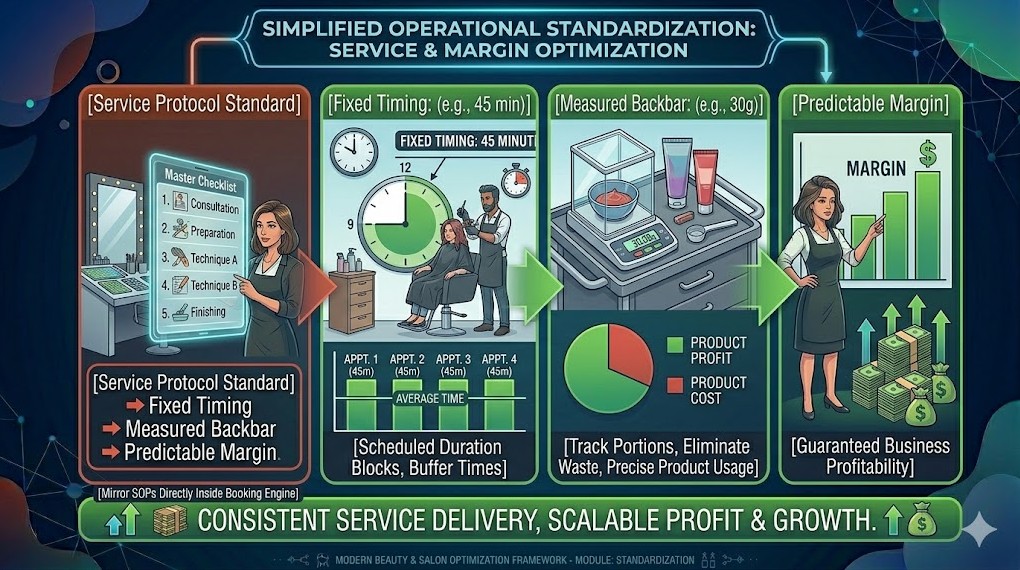
If a premium haircut and style is scheduled for 45 minutes at Location A, it cannot drag on for 75 minutes at Location B simply because of poor time management. Having clear scheduling parameters helps keep profit margins clear. Standard operating procedures (SOPs) across locations must be mirrored directly inside your digital booking engine. Every service tier across all branches must feature matching default duration blocks and automated cleanup buffers. This technical alignment ensures that your calendar remains airtight and your clients can accurately plan their days, regardless of the branch they choose to visit.
A sophisticated multi-location salon caters to its clientele. Corporate professionals often prefer booking mid-week touch-ups at a salon near their office while reserving complex, high-ticket color or extension transformations for a suburban branch.
If your software architecture isolates your client databases by zip code, this flexibility becomes an operational nightmare. A client walking into your secondary location becomes an anonymous stranger. Their technical color formulas, allergy history, past service notes, purchasing habits, and tipping preferences are left trapped in an isolated database at the primary branch. This data fragmentation forces the technician to work blindly and damages the client’s perception of your brand.
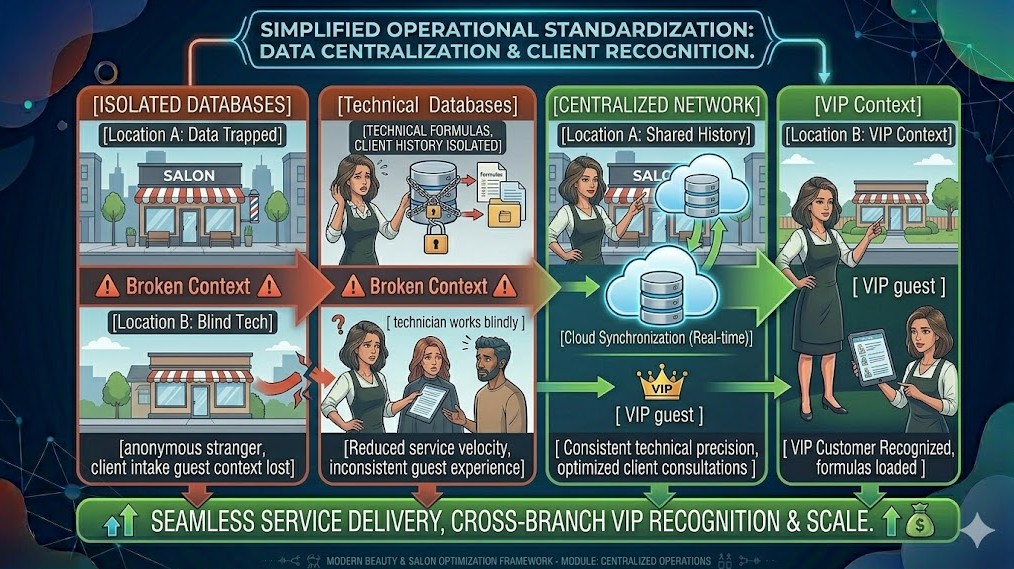
Your business must run on a unified, centralized cloud client database for a premium client experience. When a guest checks in at any location under your brand banner, the local receptionist and technician must instantly have a clear view of their entire client profile. Access to real-time data ensures your team can seamlessly recreate complex technical styles, honor historical service preferences, and maintain absolute consistency across your entire physical network.
Personnel is the single largest variable expense in the service industry, and managing human resources across multiple properties introduces new operational complexity. Labor optimization in a multi-shop setup is no longer just about filling empty chairs; it is about dynamic resource allocation—ensuring that your highest-performing employees are positioned exactly where market demand peaks at any given hour of the working week.
A major operational benefit of expanding your physical footprint is the ability to leverage a shared talent pool. When a single location faces an unexpected staffing shortage due to illness or sudden vacations, it often results in lost revenue, frantic schedule re-arrangements, and frustrated clients. In a multi-location network, your other branches function as a strategic safety valve.
However, rotating service providers between locations requires flawless administrative coordination. If a master stylist works at Location A on Tuesdays and Thursdays, but shifts to Location B on Fridays and Saturdays, their digital calendar must automatically adjust across your entire network in real time.
Manual booking systems are an invitation for double-booking disasters. If a client books an appointment online via a localized branch calendar while that technician has been dynamically reallocated to clear a waitlist at another branch, you instantly break client trust. Your system must allow for complex multi-site staff scheduling, linking an individual technician's profile to multiple physical locations while continuously syncing their real-time availability to a single master calendar.
Managing payroll across a multi-branch enterprise becomes mathematically challenging when staff members split their working hours across different properties. A technician may generate $2,000 in service revenue at your high-ticket urban center during the first half of the week, and another $1,500 at your suburban outpost over the weekend. Tracking these split revenue streams manually via separate point-of-sale reports introduces massive administrative overhead and increases the risk of accounting errors.
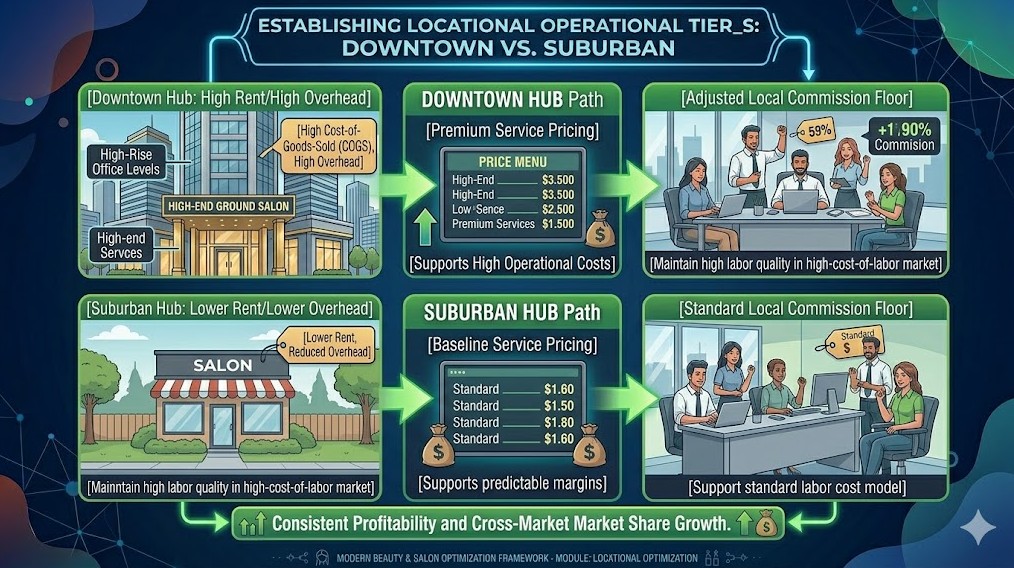
Because your price menu and cost of goods sold (COGS) could fluctuate by zip code, your backend payroll architecture must be capable of processing location-specific commission rules. To scale without drowning in paperwork, you need a centralized cloud payroll engine that automatically tracks every single transaction across all locations, matches them to the technician ID, applies the appropriate regional commission split or hourly rate, and generates an integrated, audit-ready payroll report at the end of every week.
Inventory management is often the most significant drain on a business's cash flow. When operating a single salon, managing stock levels can be a visual task—you look at the backbar shelves and reorder polish, developers, or retail products when bottles run low. However, when your business scales across multiple properties, unengineered inventory management turns your shelves into a graveyard of dead capital.
Every bottle of premium product sitting unused for six months at one branch is cash that should be funding localized marketing or payroll optimizations at another. To protect your brand's profit margins, you must treat your supply chains with institutional precision.
Scaling up gives you the financial advantage of bulk purchasing power. Buying backbar consumables and retail lines in massive quantities allows you to negotiate deep wholesale discounts from distributors, drastically lowering your cost of goods sold (COGS). However, distributing these products effectively requires shifting away from loose, site-specific ordering and adopting a centralized framework.
The Central Distribution Method treats your primary location or a dedicated storage hub as the master warehouse. Instead of each branch placing independent orders, inventory is funneled through your central hub and redistributed based on real-time consumption data.
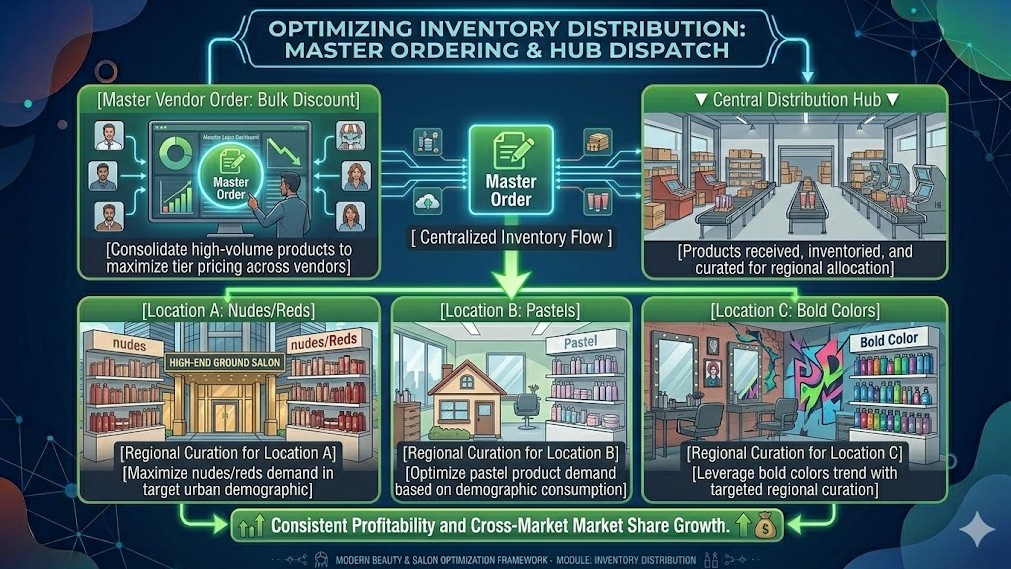
This flexibility is vital because product trends vary widely by location. For example, your high-fashion urban branch may completely burn through bold nail art charms or specialized vivid hair tones, while those same premium products sit completely untouched on the shelves of your classic suburban outpost.
Instead of letting dead stock rot in a cupboard, an automated system helps you execute seamless inter-salon product transfers. Digitally moving product from where it stalls to where it sells minimizes waste and maximizes your inventory turnover rate across the entire enterprise.
While central distribution provides high-level control, day-to-day stability requires automation at the local branch level. Every single storefront must operate under strict "par levels"—the absolute minimum amount of a specific product required on hand to sustain operations until the next delivery arrives.
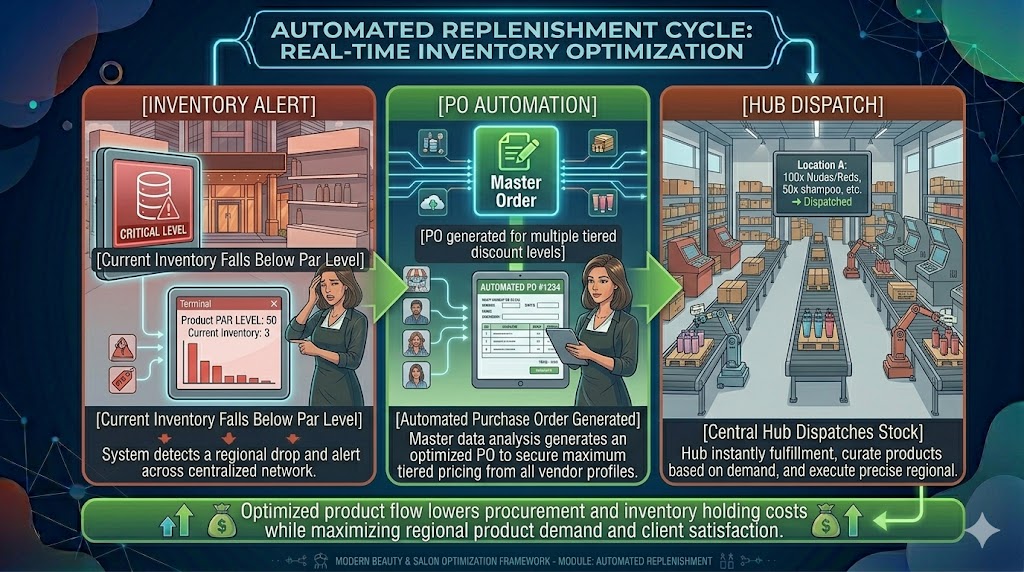
Managing this manually across multiple locations is a recipe for operational failure. A busy branch manager should never have to spend their Saturday evenings counting tubes of color or bottles of topcoat.
To scale efficiently, your inventory architecture must map out separate digital warehouse profiles for each physical location. As your technicians check out clients and log used products, your point-of-sale system should automatically deduct those materials from that specific location's digital stock. Once a product hits its local par baseline, the system automatically triggers an alert or creates a purchase order, guaranteeing that your staff never faces a service bottleneck due to missing inventory.
The ultimate limiting factor of business expansion isn't capital or real estate; it is managerial bandwidth. As an owner, you cannot personally oversee every checkout, inspect every backbar station, or listen to every front-desk interaction across several properties. Your presence must be replaced by an airtight, cloud-based software engine that translates physical actions into actionable, unified data streams.
To drive real business growth, you must move away from retrospective accounting. Waiting until the end of the month or quarter to piece together separate financial reports from different branches leaves your business highly vulnerable. If a specific location is hemorrhaging profit due to skyrocketing utility costs or a sudden spike in unbooked downtime, you need to catch that leak instantly.
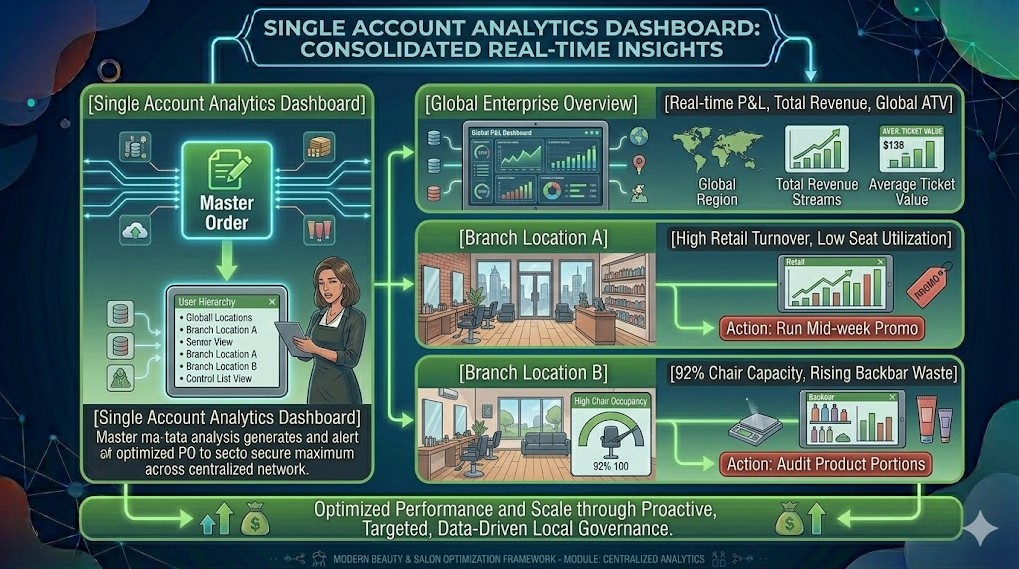
A truly enterprise-grade multi-location platform gives you a centralized reporting dashboard that pulls real-time information from every storefront into one interface. With a single login, you can instantly monitor your macro performance metrics: global Profit and Loss (P&L), Average Ticket Value (ATV), and individual staff productivity.
Crucially, this architecture allows you to track your Seat Utilization Rate per location. If your downtown branch is running at an 85% chair capacity while your uptown branch is languishing at 42%, you have immediate, data-backed insight. This visibility allows you to instantly deploy targeted marketing automations or redistribute promotional efforts to optimize your revenue per square foot across the entire brand.
As your company and team expand, protecting your proprietary data and system configurations becomes paramount. A single-location salon can often operate with loose software permissions, but a multi-site enterprise requires strict, tiered access control (multi-tenant security) to prevent operational chaos.
Your software system must feature highly customizable user roles that restrict data access based on employment hierarchy:
Hardcoding these security perimeters directly into your platform protects your business from data leaks, prevents unauthorized menu price changes at local desks, and ensures that your entire multi-branch ecosystem runs smoothly, securely, and with absolute accountability.
Expanding to multiple salons is growth that separates intuitive artists from data-driven entrepreneurs. True, sustainable scale is never achieved by simply replicating physical chairs; it is built by engineering an unbreakable, cloud-linked infrastructure that transforms separate outposts into a unified economic machine.
By standardizing your operational workflows, centralizing your client and inventory data, and utilizing a powerful, multi-location software engine like Booksy, you eliminate the friction of geographical distance. You retain absolute control over your profit margins and brand experience without sacrificing your managerial sanity.
As you look to scale your brand through 2026 and beyond, stop attempting to be physically omnipresent. Build a centralized digital command center, protect your unit economics across every square foot of real estate, and watch your business scale securely from a single, streamlined point of control.
The biggest mistake is relying on organic, hands-on management. In a single salon, the owner’s physical presence fixes mistakes and maintains morale. When scaling, that presence is cut by 50%. Without hardcoding Standard Operating Procedures (SOPs) into a unified digital framework, different locations will develop isolated cultures and inconsistent service quality, fracturing the brand's reputation.
Consistency requires converting manual techniques into strict, system-enforced institutional workflows. Every service must have uniform parameters for duration blocks, automated cleanup buffers, and backbar product measurement. Furthermore, using a centralized cloud database ensures that technical formulas, allergy histories, and client preferences are shared instantly across all locations, so a VIP guest receives identical treatment anywhere.
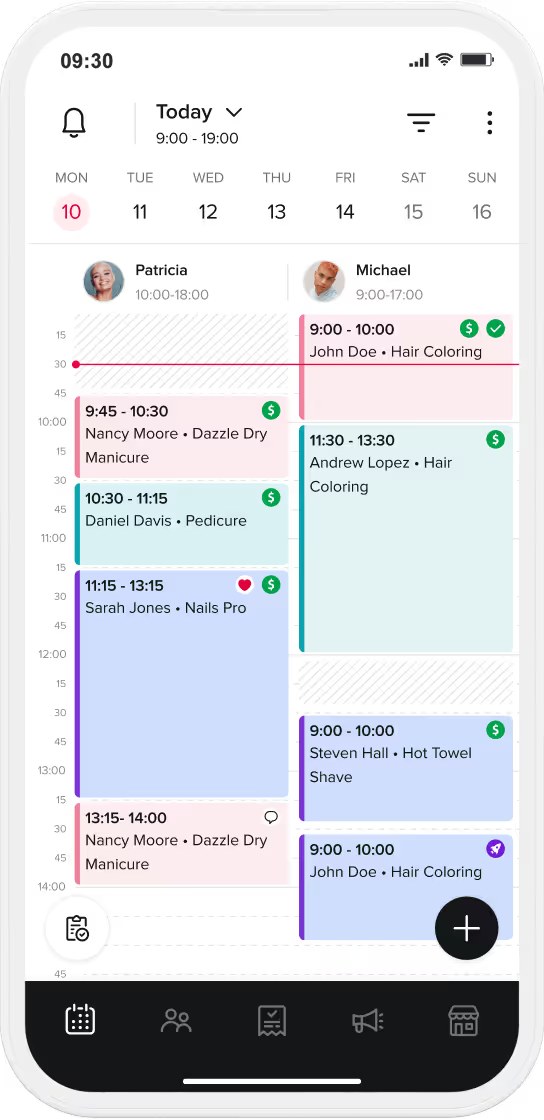
To prevent double-booking disasters and scheduling conflicts, you must avoid isolated, local calendar accounts. Your business needs an enterprise-grade booking platform that links an individual technician's profile to multiple physical locations. This ensures that when a stylist is rotated to clear a waitlist at Branch B, their availability automatically updates and syncs across the entire network master calendar in real-time.
Instead of allowing branch managers to place site-specific orders, the Central Distribution Method routes all procurement through a primary warehouse hub to leverage bulk discounts. Stock is then distributed to individual branches based on live consumption data. This allows for seamless inter-salon product transfers, moving slow-moving stock from one branch to another where demand is peaking, maximizing inventory turnover.
Fragmented software stacks create an information vacuum that delays P&L visibility. Profit leaks—such as rising backbar waste or labor over-allocation—become invisible because a record-breaking week at one location can mask structural deficits at another on an aggregated spreadsheet. Real-time control requires a single unified backend platform that streams live data from every chair into one centralized executive dashboard.