If you are an ambitious beauty entrepreneur who loves the aesthetic appeal of sun-kissed, radiant complexions and you want to secure a highly profitable foothold in the wellness market, launching a dedicated indoor tanning facility is an exceptional financial endeavor. However, transforming a business vision into a legally compliant, operational storefront requires navigating detailed upfront investment calculations, local health department guidelines, and strategic marketing setups. Knowing how to efficiently allocate your initial capital and which specialized tanning salon software to implement guarantees smooth daily operations from day one. In this comprehensive industry guide, we will break down the exact operational steps required to launch a successful tanning salon business and scale your organic local bookings rapidly.
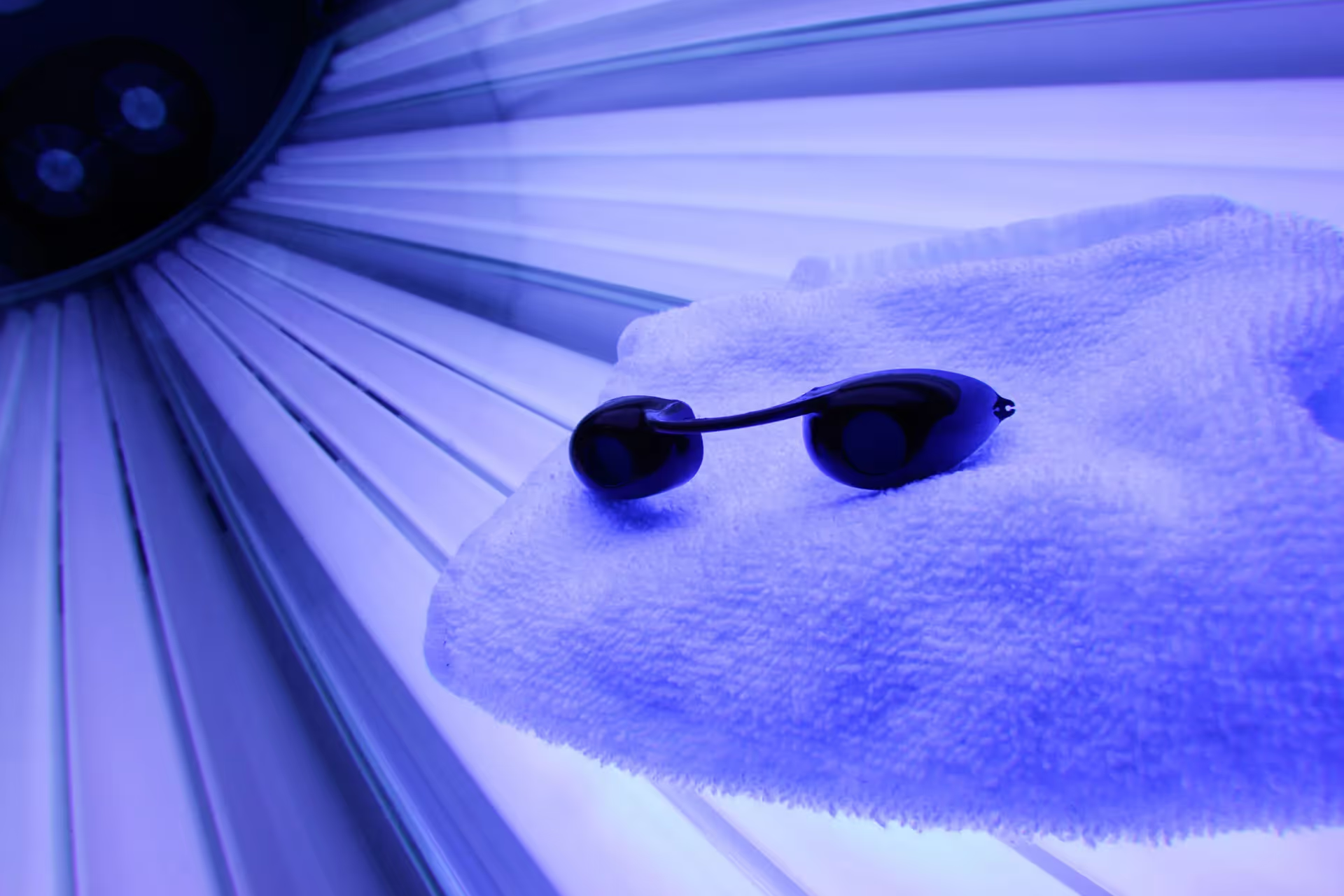
Tanning salons are businesses that give clients a golden glow all year round, no matter the weather outside. Tanning salons generally come in two forms:
These businesses are generally located in a static commercial location, though there is also the option to run a mobile tanning salon. You could equip a truck with tanning machines and devices and deliver your services by heading to your customers’ homes or by parking the vehicle in high-traffic areas.
The tanning salon industry is massive. According to IBISWorld, the market size of tanning salons is worth $4 billion, and there are 19,535 tanning businesses in the country.
Tanning beds and spray tan machines remain popular, and it’s uncommon for consumers to purchase their own to use at home — largely due to the costs and lack of expertise. This presents a fantastic opportunity for tanning salon owners. With just a few tanning beds or spray tan machines, plus a steady stream of clients, the cost of the equipment is quickly justified.
Looking for best practices on how to start a tanning salon? Like all businesses, there are steps to follow to make sure it’s set up for success.
To help you do all that, here’s a rundown of the things you should do when opening a tanning salon.
When it comes to how to open a tanning salon, it’s critical that you do your due diligence and research the industry extensively. Look up tanning salons in your area. Visit them and try to glean information by asking questions like:

Tanning services are incredible for sun-kissed skin all year round, but depending on your methods, they may come with risks. When it comes to tanning beds, for example, there are concerns with how they expose users to UV rays. Tanning beds are frowned upon by skin experts due to the increased cancer risk that may come from UV exposure.
Meanwhile, spray tan solutions may cause adverse reactions to certain skin types, so it’s important to select the right mixtures. Testing spray tans on a small area of the customer’s skin may be necessary.
There are precautions and guidelines that come with any tanning service, and you need to become an expert on these. Research the science behind these methods. Look into how they actually work and learn safe and healthy practices. You should also obtain a certification to properly demonstrate your mastery of tanning practices.
Here’s a quick list of organizations that offer tanning certifications you may want to look into
Disclaimer: The regulatory and licensing information provided below is intended solely for general informational and educational purposes. It does not constitute professional legal, financial, or certified business advice. Indoor tanning laws, UV regulations, and permit requirements vary significantly by state, county, and municipality. Before committing capital or signing a commercial lease, always consult with a licensed attorney, a qualified business accountant, and your local department of health to ensure full legal compliance within your specific jurisdiction.
Operating a high-end indoor UV facility or professional automated spray boutique demands strict compliance with federal, state, and local health safety laws to prevent expensive code violations or legal shutdowns. Figuring out exactly what license do i need to open a tanning salon should occur during your early zoning phase, as indoor tanning practices are closely monitored due to skin wellness regulations. Before welcoming your first client into a machine booth, you must systematically secure this foundational legal compliance stack:
In the US, the most common market for tanning consists of women aged 18 to 60. In some cases, where the states allow it, younger women may also be included in the demographic.
With info on who you’re targeting, you need to think of what makes your business unique. Your expert knowledge of tanning practices is a given, but what exactly will set you apart in your target market?
A good way to carve out a niche is to offer unique business experiences. For example, you could have different lighting and music, based on the customer’s preferences, or you could even make wellness packages that incorporate essential oils, bodywork, and other services.
You can also differentiate yourself through the ingredients and products that you offer. Kait, who owns the tanning salon Tans by Kait, sets her business apart by only offering vegan and organic spray tanning. Doing so allows her to zero in on her target market, which is health- and socially-conscious individuals

Accurately mapping out your upfront financial liabilities is paramount for protecting your liquid working capital during the lean initialization months of your commercial salon launch. Evaluating exactly how much does it cost to start a tanning salon requires separating one-time capital expenditures (CapEx) from ongoing monthly operating overheads, both of which fluctuate based on your target city's real estate and utility metrics. To ensure your new beauty enterprise remains highly profitable, your primary startup calculations should align with these realistic, granular industry investment brackets:
The U.S. national average for commercial lease space sits at $21.39 per square foot annually. Because a standard, high-performance tanning unit requires roughly 125 to 150 square feet of dedicated space to accommodate internal ventilation and client privacy, a competitive 10-station layout demands a minimum of 1,500 square feet. This translates to an estimated monthly base lease of $3,946.88. However, you must also budget for initial commercial deposits (typically 2 months of rent) and the physical build-out—including specialized partition walls, private locking doors, and high-end reception counters—which generally costs between $15,000 and $35,000 depending on the previous venue's condition.
This is the single largest hidden expense that catches novice tanning salon owners completely off guard. Commercial-grade UV tanning beds and high-pressure booths require heavy-duty three-phase electrical power systems and pull immense currents (often requiring dedicated 220V–240V circuits per bed). If your leased commercial building does not possess this grid capacity, hiring a certified commercial electrician to upgrade your power panel and install proper wiring loops will cost between $10,000 and $25,000. Furthermore, because running multiple UV lamps generates extreme heat, you must invest an additional $5,000 to $12,000 to heavily upgrade the property’s HVAC cooling and air extraction ventilation ductwork.
Your hardware selection will represent your largest direct out-of-pocket setup asset, where you must strategically balance brand-new equipment warranties against second-hand discount margins. Professional handheld airbrush spray tanning guns range from $175 to $350, making them highly accessible for mobile technicians. In contrast, automated, multi-angle spray tanning booths cost approximately $2,600 to $5,000 for standard models, and can scale up to $25,000 for luxury, heated self-cleaning units. Premium, high-pressure UV tanning beds range from $6,000 for standard entry-level machines to well over $30,000 per unit for high-end matrix beds equipped with built-in air conditioning and stereo interfaces.
To support your primary service launch and generate immediate, lucrative retail revenue streams, you must secure a robust starting product stock. Your initial inventory budget should range from $3,000 to $7,000 to cover wholesale orders of professional accelerator lotions, post-tan tan-extending moisturizers, and bronzing retail bottles. Additionally, you must allocate $500 to $1,500 for mandatory daily salon operations and safety supplies, including FDA-approved protective goggles, disposable sanitizing bed wipes, spray tan nose filters, foot sticky pads, and fresh salon-grade towels.
Protecting your physical business assets and automating client scheduling removes administrative friction and secures your upfront revenue. Implementing a premium, cloud-based tanning salon software platform like Booksy costs between $25 and $100 a month, starting at an incredibly competitive $29.99 per month—safeguarding your calendar with automatic SMS reminders and waitlist options. Furthermore, you must factor in specialized corporate business insurance policies (combining general liability, workers' comp, and equipment breakdown protection) which averages $3,000 annually, alongside local health department UV operating permits and zoning licenses totaling up to $500.
💡 Operational Master Tip: When finalizing your master financial launch matrix, it is highly recommended to calculate your total estimated expenditures and add a strict 10% to 20% working capital buffer on top. Having this cash emergency cushion guarantees that your business successfully covers unexpected delays in city licensing, initial utility surges, or early staff training phases without risking your primary cash flow.
Securing private investment capital, obtaining corporate bank loans, or leasing prime commercial real estate depends entirely on the structural strength and financial depth of your primary organizational documentation. Developing a rigorous, fully fleshed-out tanning salon business plan allows you to map out your long-term growth projections, minimize overhead friction, and evaluate local market competitor vulnerabilities systematically. A bank-ready, professional business plan must look past surface-level bullets to address these five specific, mandatory operational chapters:
This introductory layout acts as the primary hook for potential investors or financial institutions. It must clearly outline your salon’s corporate mission, ownership structure, and the target timeline for initialization. You should explicitly define your core value proposition here—whether you are launching a high-volume, automated smart-booth salon or a luxury, organic mobile airbrush boutique. Include a clear statement of the exact startup funding required and a brief forecast of how this initial capital injection will directly capture local market share within your first twelve months of operation.
A data-driven market layer establishes that there is active, unfulfilled consumer demand in your chosen geographic zip code. Document your target demographic metrics systematically, focusing heavily on women aged 18 to 60 who represent the highest lifetime value segment for seasonal grooming. This chapter must incorporate a strict SWOT analysis (Strengths, Weaknesses, Opportunities, Threats) of your top three local competitors, tracking their average pricing, equipment limitations, and negative customer reviews. Proving that your local market is underserved justifies your marketing entry strategy to underwriting banks.
This chapter serves as the precise operational blueprint for your daily facility workflow and inventory management. You must itemize your physical facility requirements, including high-voltage electrical grid upgrades, heavy-duty ventilation installations to manage machine heat emissions, and custom layout dimensions (allocating 125–150 square feet per tanning unit). Clearly detail your hardware procurement strategy by presenting a cost-benefit analysis of purchasing brand-new high-pressure UV beds versus certified pre-owned spray booths. Finally, explicitly list your core business tools, specifying how implementing premium tanning salon software like Booksy will automate your calendar, manage employee shifts, and protect revenue from day one.
Your business plan must outline a clear monetization strategy that proves how the business will generate sustainable monthly cash flow outside of basic walk-in services. Define your core service tiers structurally, detailing the margins on single UV sessions, customized airbrush packages, and high-margin unlimited monthly membership subscriptions. Additionally, incorporate a dedicated retail sales strategy for complementary tanning accelerators, post-tan hydrating extensions, and mandatory protective eyewear. Documenting how retail product sales will contribute an estimated 20% to 30% of your total gross revenue demonstrates strong business maturity to lenders.
The financial chapter is the most heavily scrutinized section of your entire document and requires absolute arithmetic precision. You must present a comprehensive, multi-year spreadsheet layout that details your exact startup capital breakdown (allocating funds for lease deposits, equipment acquisitions, initial salon stock, and marketing hype campaigns). Provide a month-by-month cash flow forecast for the first year, followed by conservative annual profit-and-loss projections for years two through five. Crucially, calculate your exact operational break-even point—showing precisely how many active clients or monthly package sales are required each week to completely cover your fixed lease and utility overheads.
You might already have your location in mind, but when you begin to shop around, be sure to consider things like what your signage will look like at that location and if people will easily spot your business.
What are the benefits or downsides of being in a high-traffic area with high rent costs, vs. being in a lower-foot-traffic area with cheaper rent costs? Also, consider which locations require renovations to get started.
High foot traffic areas are not always necessary. You could opt to try and find locations near gyms or other health and beauty services so that those who do walk past are people who are likely to be your target market.
Your supplies and equipment are going to be some of the largest out-of-pocket expenses in setting up your tanning salon. You will have the option to buy brand new or second-hand, and you will need to weigh the benefits and costs.
Buying brand new is expensive, but second-hand equipment will require more maintenance. It’s wise to do a cost-benefit analysis on all of your options to ensure you make the best economic decision for your tanning salon.
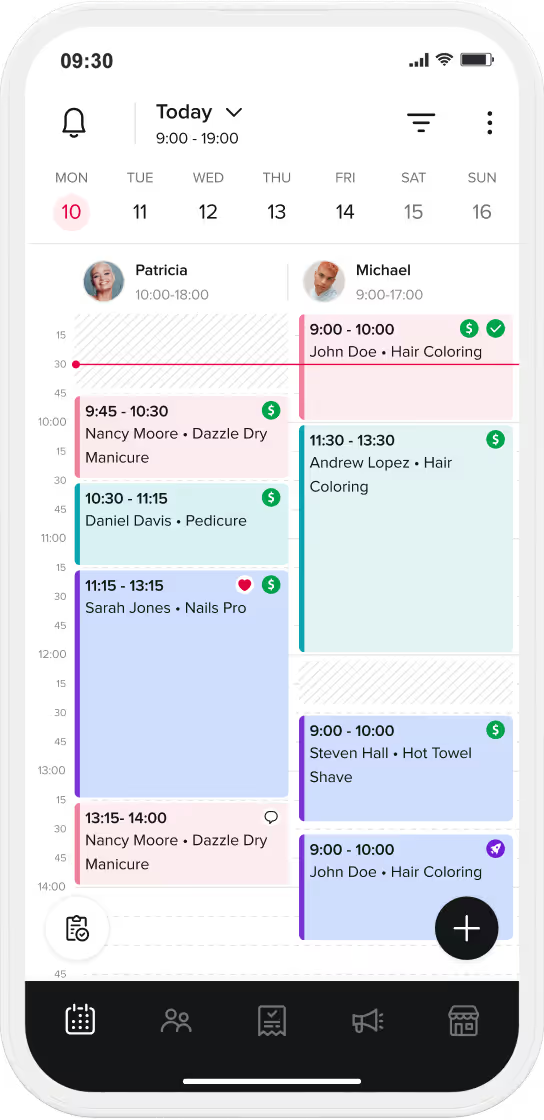
Behind every successful business are good tools and apps that help owners manage bookings and market their services. Booking software should be a top priority, as it will allow you to take bookings online and manage your calendar without having to do manual admin work. This will save you a lot of time, so you can focus on serving clients and growing your business.
In addition, a good tanning salon software can be set up to remind customers of appointments automatically, which helps minimize no-shows. Some solutions (like Booksy) even offer waitlisting capabilities, so you can quickly fill canceled appointments.
All this to say that the right tanning salon software can do wonders for both the backend of your business, as well as the client-facing side of your operations. That’s why it’s essential to pick the best one from the start.
Depending on the space, services, and the number of stations in your salon, you may need to hire a team.
Make sure you look for staff that match your enthusiasm for tanning, and if you’re looking at expanding your services, consider staff from different beauty backgrounds that may allow you to broaden your offerings.
It’s recommended that you set up a website and get into social media immediately so that you can market your tanning salon, build up an audience, and create hype before the launch.
Your website should be the place that answers all of your customers’ questions, including:
Uptown Sun Studio's website does a good job of urging clients to book. The company has prominent booking buttons on its homepage and other parts of the site to ensure that people don’t miss the chance to schedule an appointment.

Now let’s about social media. Platforms like Instagram and Facebook enable you to engage with your potential clients and industry peers. These sites and apps can help get your new tanning salon off the ground.
As such, you need to post often and have a mix of content types, including:
Be sure to add your booking link to your social media bio. Or better yet, have a booking button or website on your profile that allows people to schedule appointments at your tanning salon right from the social media app or site.
Bronzebyney does all of the above really well. Aside from having a healthy mix of various content types on her Instagram page, like below:

Beyond social media, you should search for directories and platforms on which to promote your services and register with them to get exposure to your brand.
Offline, make sure you are putting up flyers at local gyms and non-competing beauty salons. You could also encourage referrals from your network and existing clients.
Before you open your doors, do a test run of all the equipment to make sure they’re functioning properly, and see to it that your salon is spotless. You could do a trial run with friends and family to catch last-minute issues.
When it’s time to open your doors, make a big deal out of it! Shout it from the social media rooftops, treat your customers like they’re rock stars, and have fun with your brand-new tanning business.
The essential first step is completing comprehensive market and competitor research. You must evaluate the active salons in your immediate region, tracking their service menus, pricing tiers, and active bed setups to identify clear gaps in the local market that your new tanning salon business can highly capitalize on.
Initial investment totals vary based on your location and equipment choices, but a mid-sized facility typically requires between $50,000 and $150,000 to launch. This includes upfront capital for leasing retail space, purchasing automated spray booths, securing licensing, and budgeting for operational business insurance policies.
To operate legally, you must secure a standard municipal business license, a state health department UV device registration permit, and an official sales tax certificate. Additionally, your staff must hold valid professional operator credentials from recognized bodies like the NTTI to prove expertise in safe skin-exposure calculations.
A comprehensive, data-driven tanning salon business plan is vital because it proves your enterprise's operational viability to banks and private investors. Documenting your 5-year financial projections, target demographics, and local competitor research signals strong corporate responsibility and mitigates financial risk for lending institutions.
Implementing premium tanning salon software like Booksy eliminates missed appointments by automatically sending SMS text and email reminders directly to your clients. Furthermore, using advanced software options allows you to implement strict cancellation policies and secure upfront deposits, completely protecting your daily cash flow.
For personal wellness services, look for a strategic middle ground by selecting commercial spaces near complementary businesses like local gyms, fitness clubs, or hair and beauty salons. This ensures that the foot traffic passing your storefront is already part of your specific target demographic, allowing you to optimize rent costs.
You can carve out an elite market niche by curating unique premium experiences, such as integrating personalized wellness packages that combine infrared therapy with organic skincare. Specializing in highly sought-after product lines, like offering exclusively vegan and organic spray tanning solutions, instantly attracts conscious high-spending buyers.
Acquiring brand-new beds offers maximum reliability and advanced safety features but commands a heavy upfront cash investment. Second-hand machines significantly lower your initialization costs but require careful tracking of lamp hours and higher ongoing technical maintenance fees, requiring a strict cost-benefit analysis before purchase.