For salon and barbershop owners, the daily schedule layout is the engine of the business. In a highly saturated beauty and wellness market, maximizing revenue requires keeping your service stations continuously occupied. Entrepreneurs generally lean toward one of two distinct business philosophies: cultivating a premium, highly predictable appointment-only framework, or relying on the spontaneous, high-volume energy of foot traffic. A growing number of brands are attempting to merge these two worlds, building a "hybrid" model designed to capture both committed online bookers and spontaneous walk-ins.
While the hybrid concept sounds ideal on paper, managing a mixed booking flow is one of the most volatile scheduling problems an owner can face. Without strict boundaries, a hybrid schedule can create chaos. It pits clients who booked weeks in advance against impatient walk-ins who expect immediate service, turning your reception area into a high-stress bottleneck.
By setting clear operational rules, using digital queue tracking, and setting firm scheduling buffers, you can eliminate front-desk friction, protect your technician's sanity, and fully monetize every single stream of consumer traffic walking through your doors.
When your scheduling engine cannot seamlessly organize pre-booked appointments alongside real-time foot traffic, your front desk bears the brunt of the friction. The result is an unreliable environment that lowers service velocity and damages your brand's reputation.
Double-booking happens when a walk-in client is seated because a station appears temporarily open, without checking the upcoming digital calendar blocks.
If a technician with an empty chair begins a walk-in haircut at 1:45 PM while a client who booked an online appointment weeks ago is scheduled to arrive at 2:00 PM, you create an immediate operational conflict.
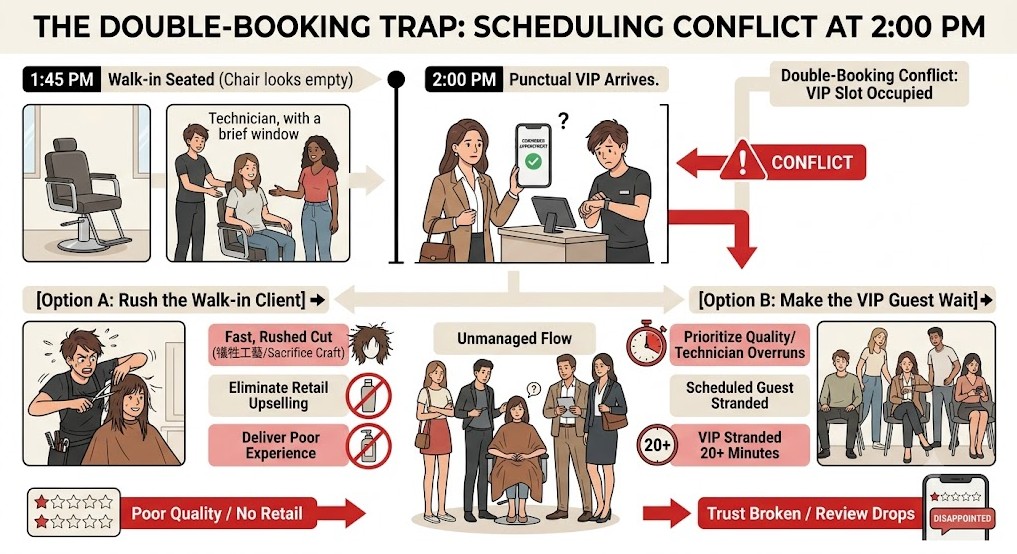
If the technician rushes through the walk-in service to finish on time, they sacrifice their craftsmanship, eliminate retail upselling, and deliver a poor experience. If they prioritize quality and overrun their time block, the scheduled guest is left stranded in the waiting area for 20 minutes past their scheduled start time.
When a salon floor is flooded with unscheduled walk-in traffic, your staff naturally defaults to executing fast, low-margin transactions (such as quick trims or basic shape-ups) just to clear the crowded waiting room.
Because the team is under high pressure to clear the physical backlog, your station velocity climbs, but your average ticket value (ATV) plunges.
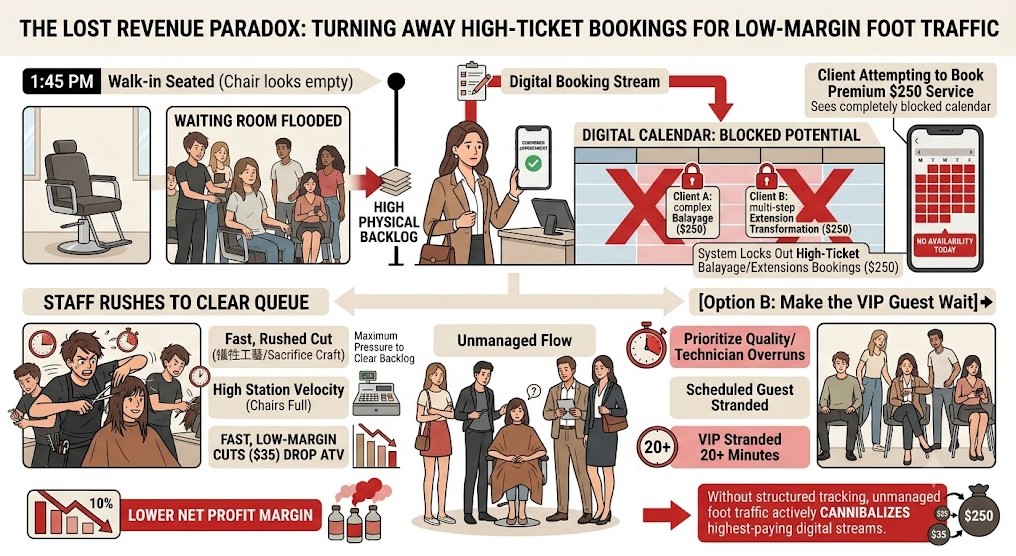
While your chairs are physically full, you are accidentally locking out high-ticket, long-duration digital bookings. A client attempting to book a premium $250 balayage or a multi-step extension transformation online will see a completely blocked calendar because your staff's time is entirely consumed by $35 walk-in cuts.
You end up burning through your expensive backbar inventory and exhausting your technicians for a high volume of low-profit traffic, while your net profit margins decline. Without structured tracking, unmanaged foot traffic actively cannibalizes your highest-paying digital booking streams.
Every business model carries distinct financial trade-offs. Your choice determines how your physical space is organized and how your software architecture must be configured to protect your margins.
The Appointment-Only Model approaches the salon floor with absolute structural discipline. Under this framework, your business doors are closed to spontaneous foot traffic. Every single block of time on your calendar must be secured via an upfront digital reservation, backed by card-on-file protection or a non-refundable deposit.
On the other hand, the pure walk-in model is built on immediate availability and high local visibility. This structure is common in classic barbershops and express nail bars located in high-traffic retail corridors or transit hubs.
The hybrid engine captures the best of both worlds, constructing a framework where pre-committed digital bookings form your financial baseline, while spontaneous walk-ins function as a high-margin accelerator to fill unexpected scheduling gaps.
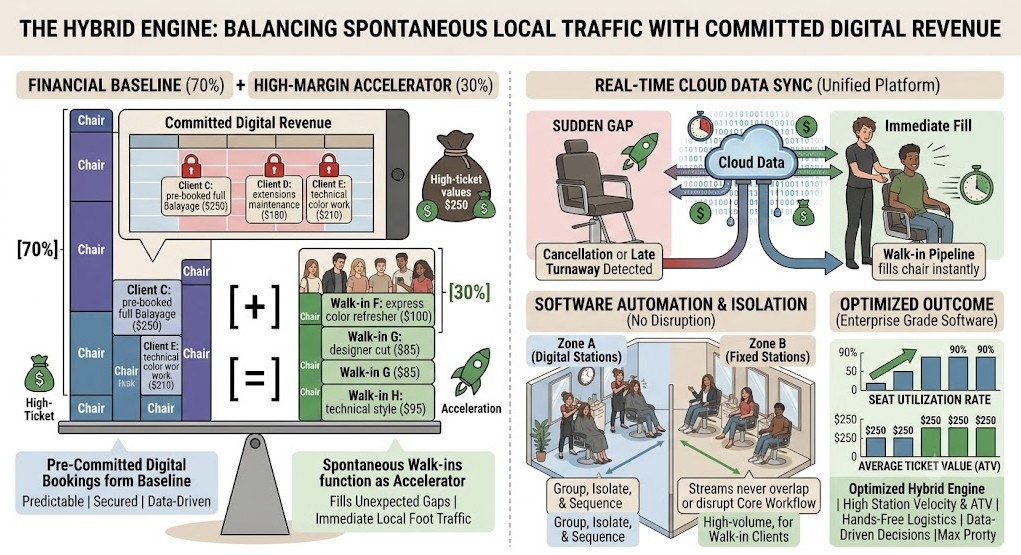
When engineered correctly, a hybrid model uses real-time cloud data to keep your seat utilization rate close to 90%. When your digital calendar faces a sudden gap due to a cancellation or a late turnaway, your walk-in pipeline immediately fills that empty chair.
Balancing this model requires shifting away from manual scheduling and towards software automation to group, isolate, and sequence your incoming client streams so they never overlap or disrupt your core workflow.
Running a high-yield hybrid salon or barbershop requires systemizing your time and scheduling. When every technician on your floor is expected to simultaneously jump back and forth between rigid online appointments and unpredictable walk-ins, scheduling conflicts are guaranteed to occur.
The most effective physical defense against schedule drift is the practice of Dedicated Chair Allocation. In this framework, you do not allow walk-in traffic to float freely onto any available chair on your floor. Instead, you split your physical real estate into two distinct operational zones: Fixed Stations and Digital Booking Stations.
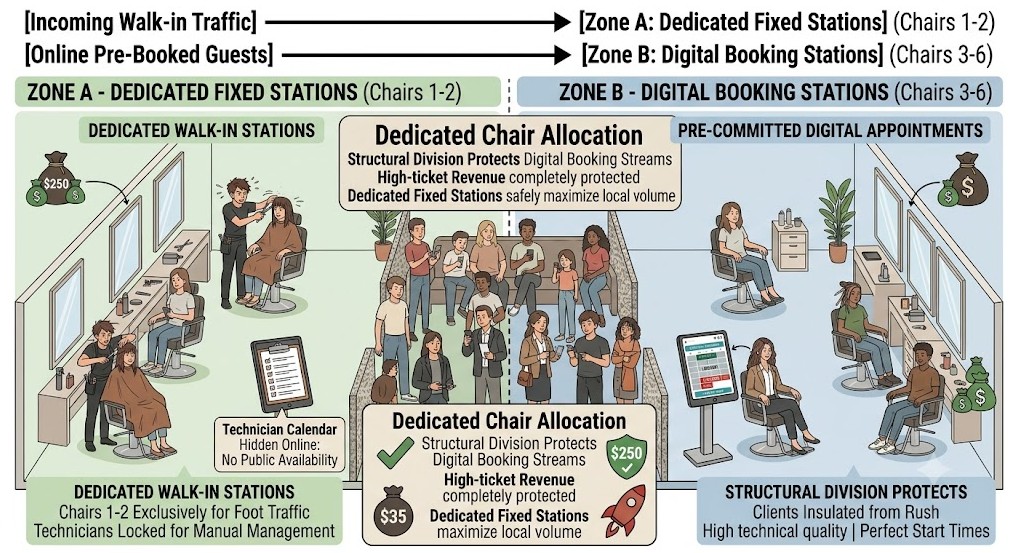
For example, in a six-chair barber shop or nail lounge, you designate Chairs 1 and 2 exclusively as your walk-in stations. The technicians assigned to these chairs do not appear on your public online booking app; their entire day is reserved for managing physical foot traffic. Chairs 3 through 6 remain completely locked for pre-committed digital appointments.
Structural division protects your digital booking streams. If a walk-in surge floods your waiting room at 2:00 PM, the clients sitting at your digital booking stations remain insulated from the rush. Their service quality remains high, their start times remain perfect, and your high-ticket digital revenue is completely protected while your dedicated fixed stations safely maximize your local volume.
For smaller salons where splitting your physical stations isn't possible due to limited chair counts, you can use the Time-Slot Cushion Strategy to manage a hybrid flow. This mathematical method allows your technicians to handle both client types by hardcoding strategic buffer blocks directly into your master calendar.
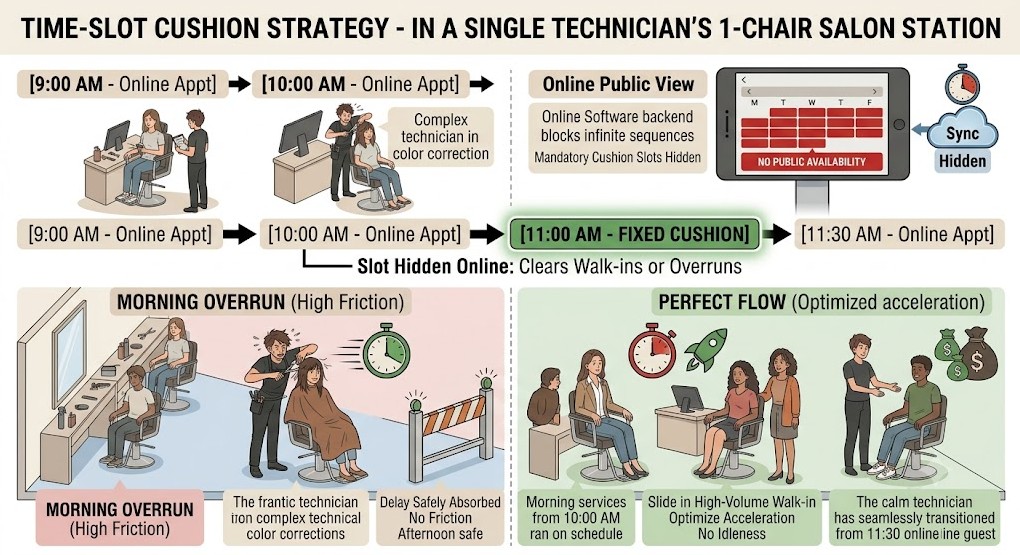
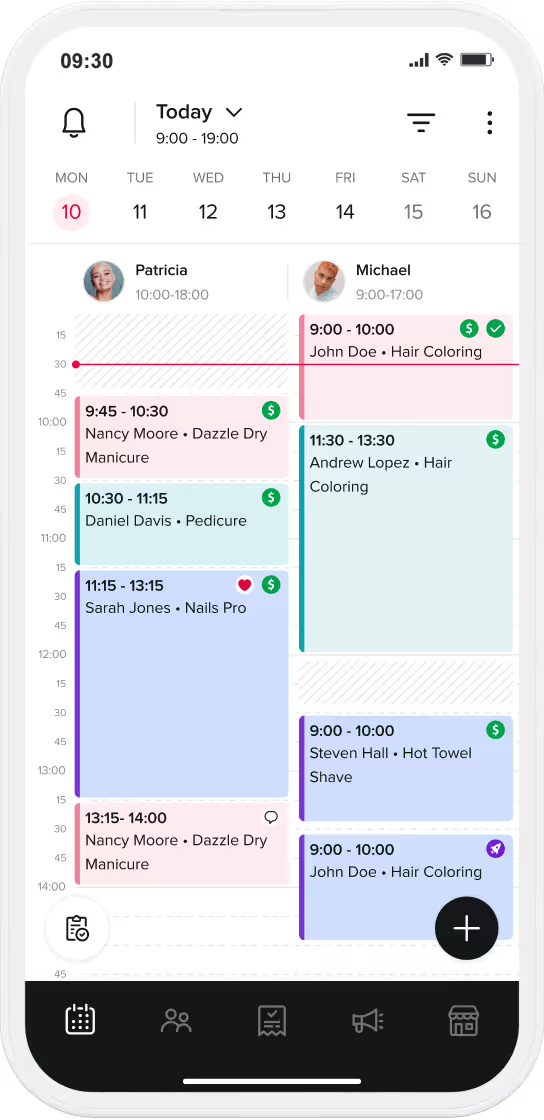
Instead of allowing your online software to display an endless sequence of back-to-back appointment blocks all day long, you internally block out specific "cushion slots" on the backend calendar that are completely hidden from public view. For instance, a technician might have pre-booked digital appointments from 9:00 AM to 11:00 AM, followed by a mandatory 30-minute internal cushion block before their 11:30 AM digital guest arrives.
If the morning services run perfectly on schedule, the front desk can immediately slide a high-volume walk-in client into that 11:00 AM cushion slot. If an online appointment overruns due to complex technical color corrections or nail art, the cushion block safely absorbs the delay. This proactive scheduling approach keeps your shop floor running smoothly and prevents morning delays from blowing up your afternoon calendar.
Boundaries are only effective if they are backed by clear communication and structured front-desk protocols. A common mistake in hybrid setups is leaving your walk-in rules unstated, which forces your front-desk receptionists to constantly negotiate wait times with impatient guests over the counter.
To maintain control of your lobby, each salon needs a formal walk-in policy. This keeps things transparent and professional for your employees and the clients.
The primary cause of customer frustration in a hybrid salon is not the actual wait time; it is the anxiety of uncertainty. When a walk-in client sits down in your lobby and is vaguely told, "It will just be a little bit," their internal clock moves slower. Every minute that passes without an update increases their frustration, especially when they see online-booked guests arrive and bypass them immediately to go straight to a chair.
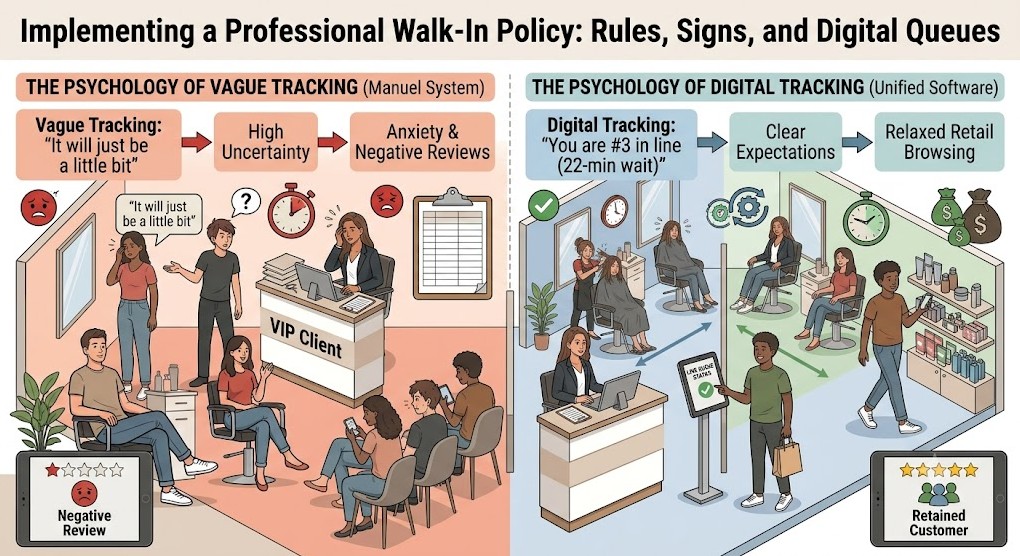
To eliminate this friction, use transparent wait-time communication powered by digital queue management. The moment a walk-in guest checks in, they must be given an exact, data-backed placement estimate: "You are currently number three in our live walk-in queue, with an estimated wait time of 22 minutes." Sharing this information removes uncertainty from the customer experience. When a client understands exactly where they stand in line, their psychological state shifts from impatient waiting to relaxed anticipation. They feel respected, stay calm, and are far more likely to spend their wait time browsing your retail shelving or stepping out to grab a coffee, rather than crowding your reception desk.
The gatekeeper of your hybrid engine is your front-desk receptionist. When a walk-in guest crosses your threshold, the receptionist should never simply ask, "What are we doing today?" and accept whatever service the client requests without checking the schedule. In a high-traffic hybrid setup, your front desk must use a strict intake script to qualify services based on current floor capacity.
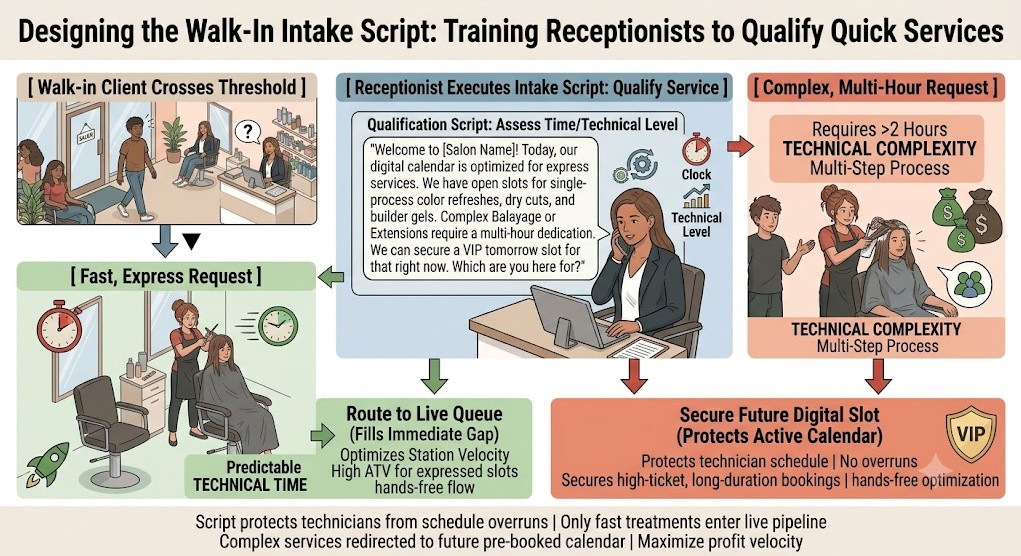
Train your front-of-house staff to use this professional intake script to manage incoming traffic:
"Welcome to [Salon Name]! Today, our digital calendar is optimized for express cut and color refreshes, along with single-tier builder gel services for our walk-in guests. We can get you right into our live queue for an express service with an estimated wait time of 15 minutes. If you are looking for a complete multi-hour transformation like a complex balayage color correction or full sculptured extensions, let’s leverage our booking engine right now to secure a dedicated VIP time block for tomorrow morning so we can guarantee the full technical time required."
Using this script allows your receptionist to control your incoming volume. It ensures that only fast, predictable, high-margin express treatments are routed into your live walk-in pipeline, while complex, long-duration services are redirected into your pre-booked digital calendar, protecting your technicians from schedule overruns.
Even the most highly trained front-desk staff can become overwhelmed when a sudden rush of foot traffic hits the salon lobby simultaneously. In a traditional brick-and-mortar business model, managing an unexpected wave of unscheduled drop-ins requires manual clipboard tracking, constant phone interruptions, and an overcrowded waiting room. This old-school setup creates immediate friction and damages the calm atmosphere your pre-booked guests expect.
To scale your operations safely, you must practice digital self-defense. Use a mobile cloud architecture to convert physical, unscheduled walk-ins into organized digital appointments before they ever set foot near a cutting or styling station.
The ultimate weapon in digital self-defense is the deployment of a QR-Code Sidewalk Funnel. In high-traffic retail corridors, consumers frequently peer through a salon's window or walk up to the door, see a crowded waiting room, and walk away because they assume the wait time is too long. They represent a massive pool of lost local revenue.
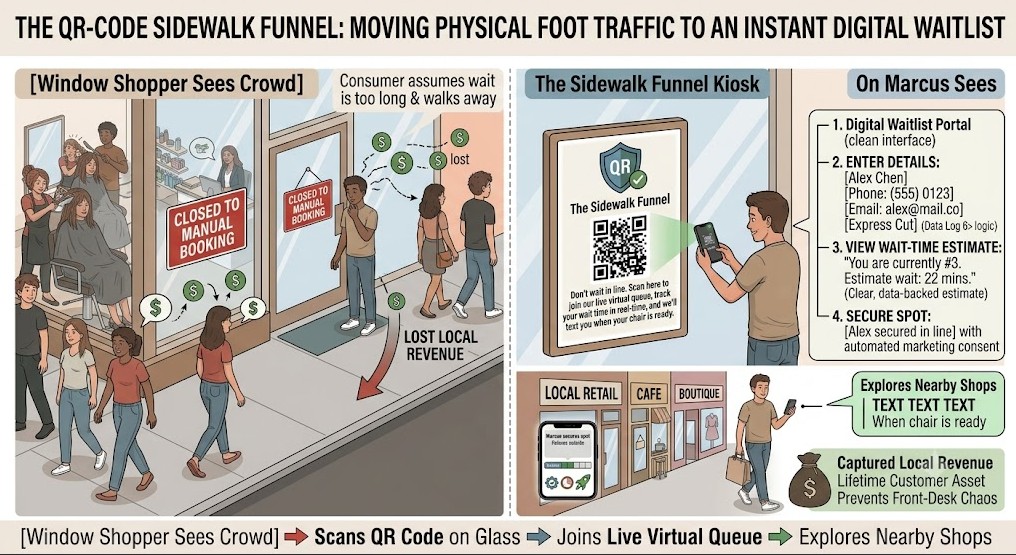
To capture this traffic without causing front-desk chaos, place a prominent, beautifully branded frame directly on your front window featuring a localized QR code. The call-to-action is simple: "Don't wait in line. Scan here to join our live virtual queue, track your wait time in real-time, and we’ll text you when your chair is ready." When a passing consumer scans the code with their smartphone, they are instantly directed to your digital waitlist portal. They enter their service selection and details, view an exact data-backed wait-time estimate, and secure their place in line without ever talking to a receptionist.
The greatest structural deficit of the traditional walk-in business model is that it treats local clients as anonymous, short-term transactions. A walk-in guest checks in manually, pays cash or card at the counter, leaves the shop, and remains a complete ghost to your business engine. You have zero means of contacting them, tracking their behavior, or marketing to them to drive retention.
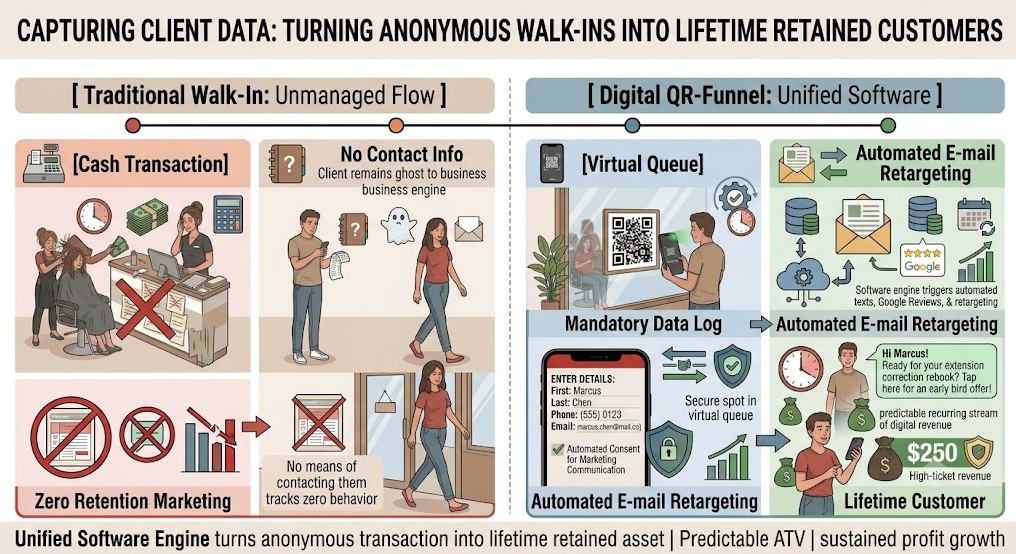
By forcing all foot traffic to flow through a digital QR-code funnel or an iPad check-in kiosk at your front desk, you turn an anonymous transaction into a lifetime retained customer asset. To secure a spot in the virtual queue, the system requires the client to input their first name, last name, phone number, and email address, while giving automated consent for marketing communication.
After they leave, your salon software engine can automatically send them automated thank-you texts, request Google Reviews, or deploy targeted email retargeting campaigns featuring rebooking incentives three weeks later, turning a one-time drop-in into a predictable, recurring stream of digital revenue.
Operating a highly profitable hybrid model is structurally impossible if your staff is forced to jump between paper waitlists, manual clipboards, and independent online booking accounts. To scale a business with multiple booking streams seamlessly, your front desk must run on a unified, enterprise-grade cloud management system.
The core operational engine of a successful hybrid salon is Real-Time Seat Utilization Synchronization.
When an unscheduled guest joins your virtual queue via the sidewalk QR code, the software doesn't just place them on a static list; it analyzes your live calendar metrics across every active technician profile in the building.
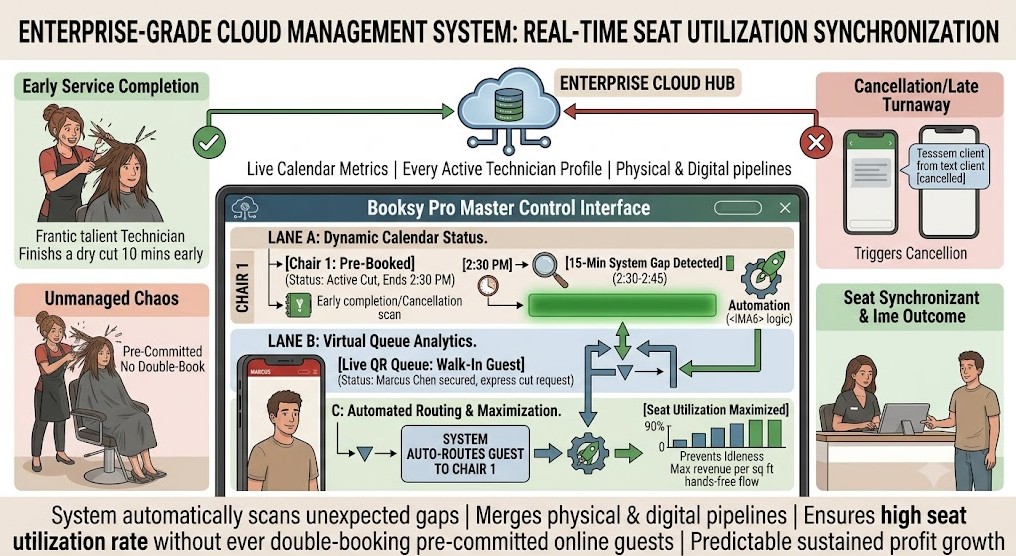
The system automatically scans for unexpected gaps caused by early service completions, cancellations, or late turnaways. If a master nail tech or barber finishes a service ten minutes ahead of schedule, the software detects the gap and routes the top client from your digital walk-in queue straight to that technician's chair.
Merging your physical and digital booking pipelines prevents your staff from sitting idle, maximizes your revenue per square foot, and ensures your salon maintains a high seat utilization rate without ever double-booking a pre-committed online guest.
Once a walk-in client is logged into your digital queue, keeping them engaged outside your physical walls requires communication consistency. If a client leaves your lobby to grab a coffee across the street, but your staff has no automated mechanism to alert them when their chair is ready, your floor velocity will instantly suffer. A technician will end up standing idle next to an empty chair while the front desk frantically dials a phone number or looks out the window for the missing client.
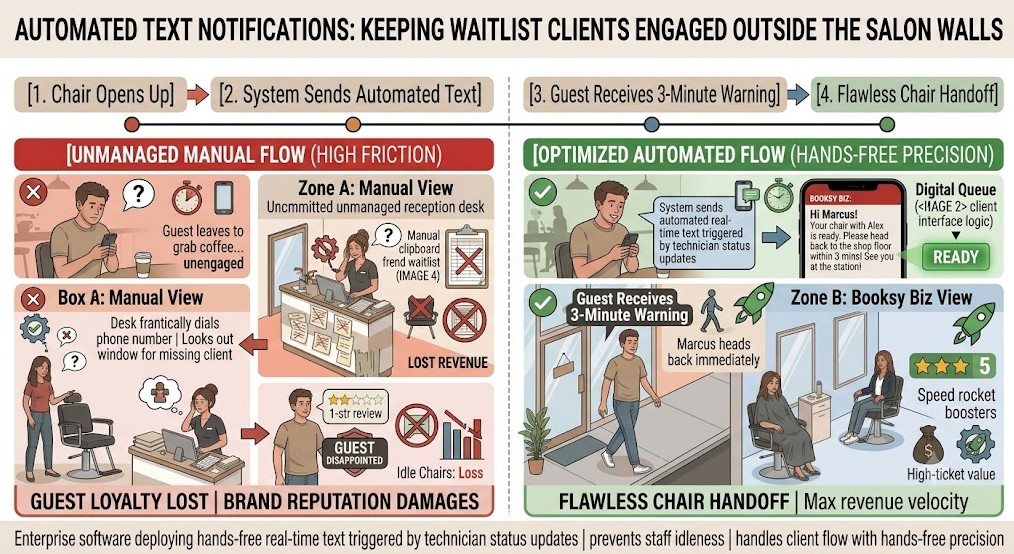
Enterprise software eliminates this friction by deploying automated, real-time text sequences triggered by system status updates. When a technician marks an active appointment as finalized, the software automatically triggers a personalized text message to the top client in the virtual queue: "Hi Marcus! Your chair with Alex is ready. Please head back to the shop floor within the next 3 minutes so we can secure your full styling slot. See you at the station!" Automating this notification process handles your client flow with hands-free precision.
Building a highly successful, resilient hybrid salon or barbershop is a structural evolution that requires shifting your focus from reactive front-desk hustle to precise time logistics. Capturing spontaneous local foot traffic and securing long-term digital bookings are both incredibly valuable revenue drivers, but allowing them to collide without a system framework will destroy your brand's efficiency.
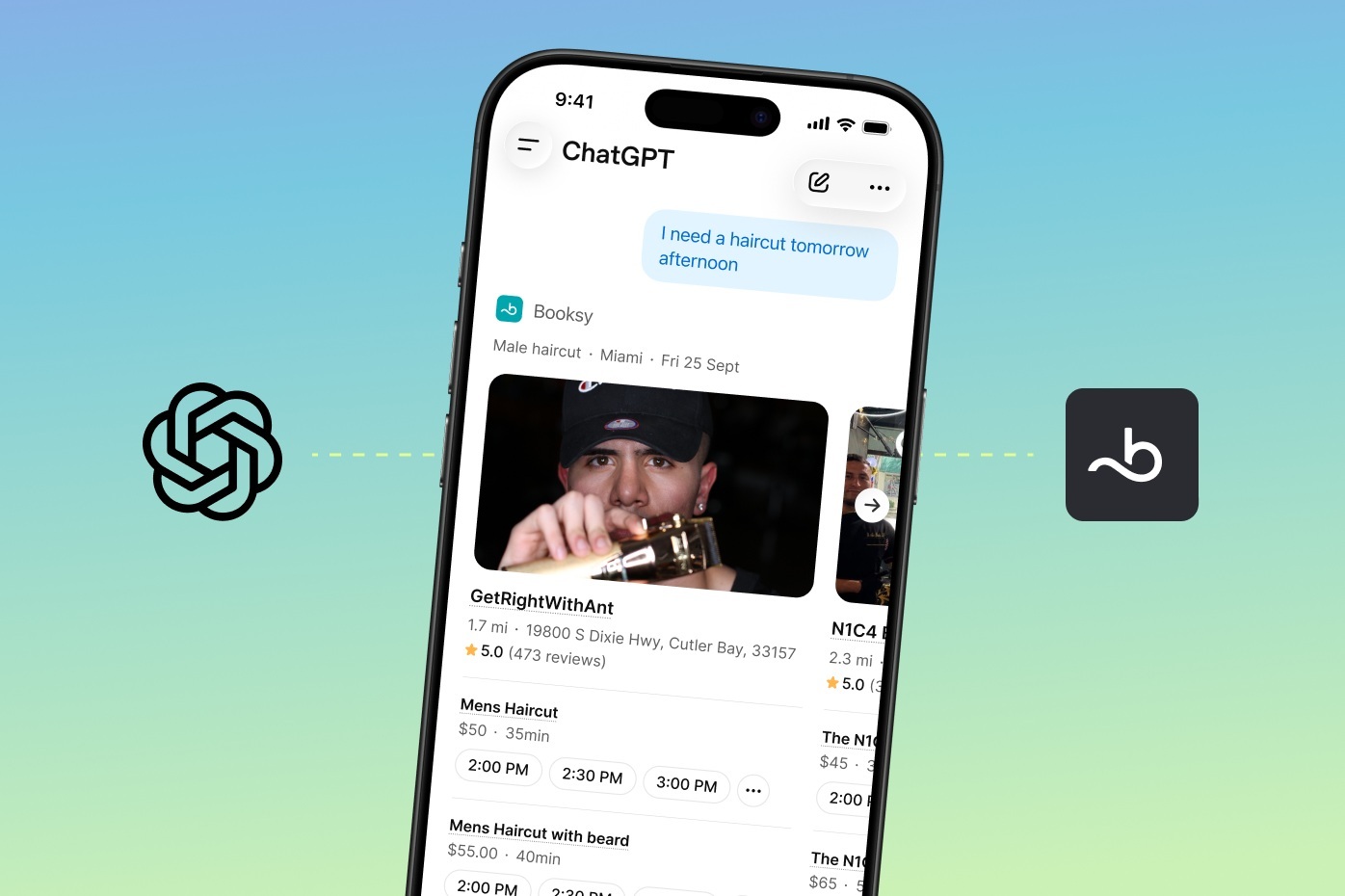
The unmanaged hybrid model is an invitation for operational chaos, bad reviews, and employee burnout. By implementing dedicated chair allocations, using smart cushion buffers to protect your time slots, and using digital virtual queues like Booksy to organize your walk-in pipeline, you completely remove the guesswork from your front desk.
Do not allow your business to operate in a permanent state of scheduling anxiety. Transition from an overwhelmed manager into a data-driven business operator. Secure your storefront traffic with an enterprise-grade cloud software engine, set firm, professional boundaries for all incoming client streams, and build a high-performance beauty brand designed for maximum seat utilization, predictable margins, and long-term financial freedom.