In recent years, the beauty and wellness industry has given focus to the solo booth rental and salon suite movement. Independent contracting was marketed as the ultimate paradise for hair stylists, barbers, and estheticians. In 2026, the honeymoon phase of the suite rental trend is officially over. Independent beauty pros are experiencing massive burnout from handling their own marketing, tracking inventory, paying heavy self-employment taxes, and working in professional isolation.
Because of this, we are witnessing a massive renaissance of the traditional salon group. But modern talent will not return to the constant hustle mentality of the past. To capture the best talent and build a sustainable business, you must know how to build a modern infrastructure.
This guide explains how to run a commission-based salon that protects your business margins, fosters an elite team culture, and turns your staff into high-earning profit partners.
To manage a thriving team, you have to understand the psychological shift happening in the workforce. Stylists are no longer just looking for a chair; they are looking for security, career progression, and a brand that elevates their personal authority.
When a commission stylist leaves a team to rent a private suite, they assume they will keep 100% of their revenue. Within six months, the reality check hits. They realize they are spending 10 hours a week outside of their service hours responding to customer complaints, manually ordering color tubes, managing website domains, and paying accountant fees. When they get sick or take a vacation, their income drops to zero.
A modern commission salon solves this burnout. By handling 100% of the administrative burden, providing premium continuous education, and guaranteeing a consistent flow of premium walk-in traffic, you offer an elite environment where artists can focus strictly on their craft while enjoying predictable, protected wealth.
The modern workforce treats your salon layout as an incubator for their personal career. If your brand offers no educational paths, toxic internal competition, and erratic payroll tracking, your retention rate will be low. To win, your operational strategy must showcase clear pathways where a junior artist can realistically scale into a master educator or shareholder within your enterprise.
The biggest financial mistake a salon owner can make is relying on traditional arbitrary commission percentages. If you are running a 60/40 commission split salon where the stylist takes 60% of the service ticket, you are likely losing money on every single client after factoring in backbar product consumption, utility inflation, lease maintenance, and credit card processing merchant fees.
A flat split treats every hour of operation identically, which completely defies basic business economics. When a stylist is slow or building their book, the salon absorbs financial risk by providing the space, marketing capital, and administrative costs. If you reward that stylist with a fixed high percentage from day one, you leave your business without cash reserves to reinvest in corporate growth, high-end equipment upgrades, or premium brand marketing.
The most profitable solution for 2026 is a dynamic commission scale. This framework rewards performance, creates healthy internal motivation, and completely shields the salon owner from absorbing unfair financial liabilities during slow seasons.
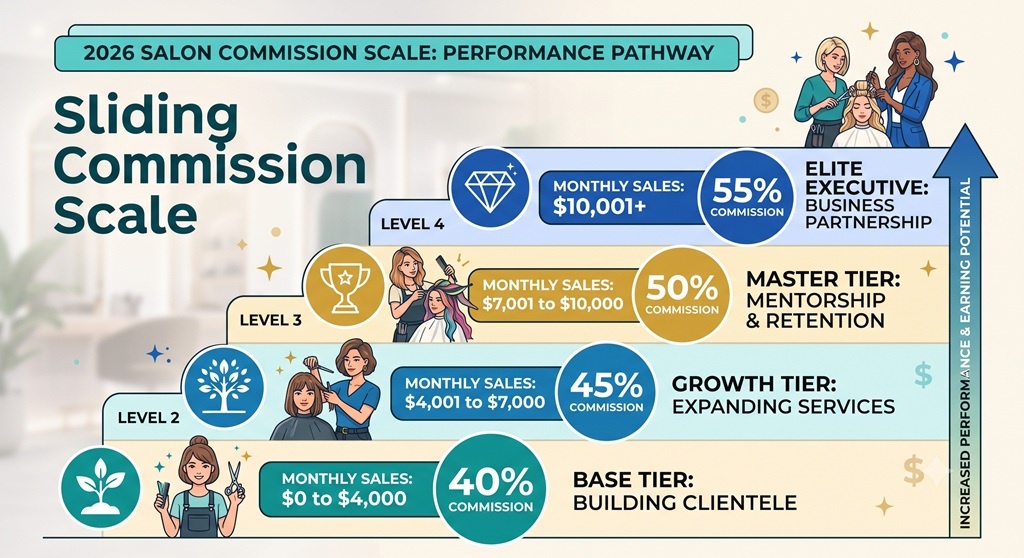
By structuring your payroll around financial milestones, your staff understands that making more money is in their own hands. If they want a higher split, they have to leverage your salon technology to increase their booking frequency,upsell premium treatments, and maintain high pre-booking rates.
For select premium day spas and avant-garde beauty concepts, traditional per-service commissions are replaced entirely by Team-Based Pay (TBP) structures. Under a TBP framework, your staff receives a highly competitive, stable hourly wage or salary paired with collective salon profit-sharing bonuses. This eliminates internal client poaching and "chair territorialism," turning your environment into a highly collaborative, unified culture where every worker is motivated to help their colleague succeed.
Executing payroll inside a commission-based model requires a blend of clear data logging and legal compliance.
Never calculate a stylist’s commission split off the raw, gross service ticket. If a client undergoes a complex balayage and vivid transformation that costs $300, your business might use $45 worth of premium lightener, developer, toners, and bond-builders from the backbar inventory.
To run a clean business, your hair stylist commission agreement must dictate a formal product charge deduction before the commission split is applied.
How it works in practice:
If the stylist is on a 50% tier, they receive 50% of the $255 net revenue ($127.50), rather than 50% of the gross $300 ($150). This simple structural change ensures that your business automatically recovers its raw chemical material expenses, preserving your baseline product margins effortlessly.
Retail sales are the highest-margin segment of your entire enterprise. However, many creative professionals hate feeling like salespeople. To incentivize your staff, integrate a separate salon commission structure dedicated exclusively to product sales:
Government regulatory bodies and labor boards are actively cracking down on independent contractor misclassification (1099 vs. W-2 fraud). If your stylists operate on a commission basis, use your schedule tools, enforce dress codes, and dictate menu pricing, they are legally classified as W-2 Employees.
To ensure total compliance with modern salon commission laws, you must enforce a guaranteed minimum wage floor. If a commission stylist experiences an incredibly slow week and their total accumulated service commission falls below the legal minimum wage for the total hours they sat in the building, you are legally required by labor frameworks to pay them the hourly minimum wage baseline for that pay cycle. Utilizing a premium salon management software that automatically cross-references total hours logged with commission payouts is the only way to avoid catastrophic labor audits.
Operational overhead varies significantly across different service niches. Use these verified industry baseline averages to structure your platform parameters safely:
Building a highly profitable commission salon requires moving away from manual tracking and adopting a data-first managerial strategy.
The only way to retain elite staff members is to eliminate any ambiguity surrounding their career advancement. Build a visible, printed corporate career matrix that outlines exactly what a stylist must achieve to earn a promotion and a higher commission tier.
Human error in payroll calculations is the number one cause of staff distrust and sudden walkouts. Modern owners rely on centralized salon software for booth renters that automate the entire financial ecosystem. By equipping your staff with an integrated app profile, they can view their real-time progress toward their next commission tier, track their retail bonuses instantly after every checkout, and view their performance analytics transparently, turning your salon into a highly organized, professional powerhouse where top-tier artists can thrive for years to come.
While historical myths point to a flat 50/50 split, the modern industry standard for a W-2 employee sits between 40% and 55% structured on a performance-driven sliding scale. This model ensures that as a stylist's total monthly sales volume scales up, their personal commission percentage increases proportionally.
Product deductions involve subtracting the raw material expenses (such as hair color, developer, toners, or specialized skin serums) from the gross service cost before dividing the revenue with the stylist. This ensures the salon automatically covers its baseline chemical overhead, allowing both the business owner and the artist to split the remaining clean net profit safely.
Yes, a performance-based sliding commission scale is vastly superior for retaining elite talent. A flat hourly rate often creates complacency, as a stylist receives the same wage regardless of whether they hustle or sit idle. A sliding commission scale provides the ultimate structural compromise: it gives top-tier performers an unlimited earning ceiling while safeguarding the salon’s bottom line during slow business cycles.