Managing a thriving hair salon, nail studio, or barbershop in the United States requires far more than technical artistry and creative flair. Managing employees requires professional etiquette and solid workplace boundaries. When expectations are unwritten, salons are bound to experience scheduling friction, an inconsistent client experience, and internal team resentment. An employee handbook sets clear standards that protect your business and create a fair culture for long-term career growth.
Salon rules for employees are a formal set of internal policies, standards, and sanitary procedures that support all aspects of salon life.
Quick Answer: A comprehensive salon employee handbook establishes clear guidelines across five pillars: attendance and call-out protocols, workstation sanitation under State Board regulations, professional dress code, mobile device discipline, and fair compensation workflows. In the US, a clear staff policy also protects salon owners against costly misclassification audits by establishing a strict boundary between W-2 employees and independent 1099 booth renters.
| Policy Area |
Standard Rule for Staff |
Operational & Legal Purpose |
Industry Segment |
| Punctuality & Prep |
Arrive 15 minutes before the first booking; 3-hour minimum call-out notice. |
Eliminates appointment delays and protects schedule gaps. |
Hair, Nails & Barbershops |
| Sanitation & Hygiene |
Disinfect tools between every guest using EPA-registered hospital disinfectant. |
Ensures strict compliance with the State Board of Cosmetology. |
All Beauty Professionals |
| Station Dress Code |
All-black professional attire and closed-toe, slip-resistant footwear. |
OSHA safety compliance and unified brand aesthetic. |
Hair Salons & Barbershops |
| Mobile Device Discipline |
Personal phones stored in lockers; client filming requires written consent. |
Protects client privacy and maintains floor focus. |
All Establishments |
Why Every US Beauty Business Needs a Written Salon Employee Handbook
A verbal agreement is not enough when managing staff members. In the United States, commercial salon owners operate under strict labor laws, state licensing regulations, and commercial premises liability. A written, signed employee handbook serves three vital functions:
1. At-Will Employment & Wrongful Termination Defense
In almost all US states (with the exception of Montana), employment is presumed to be "at-will," meaning either the employer or employee can end the working relationship at any time for any lawful reason. A legally compliant salon employee handbook must open with an explicit At-Will Employment clause and include a signed acknowledgment form. This simple document proves the employee understood salon policies and provides strong legal defense against wrongful termination or unemployment disputes.
2. The Critical W-2 vs. 1099 Booth Renter Boundary
One important mistake for US salon owners to avoid is misclassifying workers. If your salon operates with independent booth renters or chair leasees (1099 contractors), you cannot legally enforce an employee handbook upon them. Telling a 1099 contractor when to arrive, what to wear, or how to perform their craft can lead to worker reclassification penalties, back payroll taxes, and overtime audits.
Independent booth renters should instead sign a commercial Facility Lease & Sanitation Agreement that focuses exclusively on building safety, premises access, and State Board health codes.
Your salon rules for employees must apply strictly to W-2 staff members.
3. Protecting the Salon’s Establishment License
State Boards of Cosmetology and Barbering hold the salon owner’s Establishment License responsible for violations occurring on the styling floor. If a stylist uses unsterilized shears, a manicurist reuses a single-use buffer, or a barber fails to dispose of a razor blade in a biohazard sharps container, the owner faces state fines or license suspension. Codifying sanitary requirements in a mandatory handbook ensures that every team member understands their personal legal duty.
Core Policy Categories Every Salon Staff Handbook Must Cover
To build an effective, practical guide that staff respect and follow, focus on these foundational pillars:
1. Attendance, Punctuality & Call-Out Protocols
Time is a salon’s primary inventory. When a stylist is 10 minutes late, the entire day's schedule cascades into delays. Clear scheduling policies must outline:
- The 15-Minute Rule: Staff must arrive at least 15 minutes before their first scheduled booking to review formulas, set up sanitized tools, and prepare client drape capes.
- Emergency Call-Out Notice: Staff must provide a minimum of 2 to 3 hours' notice before opening if an unexpected illness prevents them from working, allowing front-desk managers to reschedule guests calmly. Unexcused no-shows trigger formal disciplinary review.
- Vacation & Time-Off Requests: Mandatory 2-to-4-week booking windows for planned time off to prevent chair shortages ahead of peak retail weekends and holidays.
2. Station Floor Demeanor & Professional Etiquette
Clients visit salons, nail studios, and barbershops to relax and recharge. The atmosphere on the service floor directly impacts client retention and average tips:
- The "Salon Floor Voice": Prohibit inappropriate personal conversations across workstations. Topics like politics, religion, vulgar gossip, or complaining about other salon guests are strictly forbidden.
- The 60-Second Greeting Standard: Every guest entering the reception lounge must be greeted warmly within 60 seconds, and offered coat check and complimentary beverages.
- Consultation Protocol: Stylists must complete a thorough 3-to-5-minute consultation before shampooing or cutting, reviewing inspiration photos, hair history, and service pricing upfront.
3. Professional Dress Code & Safety Footwear
Salon employees work to balance their visual aesthetics with Occupational Safety and Health Administration (OSHA) hazard standards:
- Slip-Resistant, Closed-Toe Shoes: Stylists frequently drop sharp shears or hot curling wands, and water splashes near wash basins. Closed-toe, slip-resistant shoes are mandatory to prevent puncture wounds and slips.
- Professional Attire: Clear guidelines establishing an all-black dress code, branded salon aprons, or tailored business-casual attire, ensuring staff look polished, clean, and distinct from walk-in visitors.
Mobile Devices & Social Media Filming Rules on the Salon Floor
While Instagram, TikTok, and YouTube Shorts drive modern salon client acquisition, unregulated smartphone usage on the service floor quickly erodes professionalism and breaches guest privacy. A structured handbook establishes clear boundaries for digital engagement:
- Personal Phone Storage: Personal texting, social media scrolling, and phone calls are strictly restricted to staff breakrooms. Stylists must keep phones on silent in lockers during service hours.
- Client Privacy & Consent: Filming or photographing a client for social media portfolio showcases requires explicit verbal and signed digital photo release consent. Never film a guest who has requested a quiet or private appointment.
- Brand Tagging & Attribution: When staff posts hair or nail transformations completed on salon premises, they must tag the official salon handle and location tag. Reposting content that disparages clients, reveals confidential salon pricing, or tags direct local competitors is grounds for termination.
- No Filming in Sensitive Zones: Recording video or taking photos in client changing suites, restroom corridors, or employee break areas is strictly forbidden.
Industry-Specific Rules: Hair Salons vs. Nail Studios vs. Barbershops
Risks vary dramatically across different beauty disciplines. An effective US handbook contains dedicated operational playbook tailored to your specific craft:
1. Hair Salon Rules: Chemical Protocols & Dispensary Management
Chemical services (balayage, relaxers, permanent waving, bleach lightening) carry the highest liability in hair salons. Specific employee rules include:
- Mandatory Allergy Patch Testing: Perform a 24-hour patch test behind the ear for all first-time color clients or clients returning after a six-month lapse.
- Color Bar Dispensary Discipline: Weigh color, developers, and lighteners accurately on digital scales. Over-mixing chemicals can leads thousands of dollars in wasted backbar inventory annually. Stylists must clean, wipe down, and sanitize bowls, whisks, and tint brushes immediately after formulation.
- Shampoo Basin Etiquette: Never leave a toning client unattended at the shampoo bowl. Wipe the neck rest with medical disinfectant and drape clean towels between every service.
2. Nail Salon Rules & Regulations: Florida & National Sanitation Standards
Nail studios operate under heightened scrutiny from state health departments and State Boards of Cosmetology (such as Florida DBPR or Texas TDLR) regarding cross-contamination and hazardous fumes:
- Single-Use Disposables: Porous implements—including emery boards, wooden cuticle pushers, pumice stones, and foam buffers—cannot be disinfected. They must be gifted to the client or discarded immediately into closed waste bins after each service.
- Autoclaves & Tool Pouches: Metal implements (cuticle nippers, steel pushers, drill bits) must be scrubbed with soap and water, submerged in EPA-registered hospital disinfectant or sterilized in a medical-grade autoclave, and stored in sealed sterilization pouches opened directly in front of the client.
- Pedicure Tub Disinfection Logs: Whirlpool foot spas and magnetic jet basins must undergo complete mechanical flushing, scrubbing with detergent, and soaking in bactericidal/fungicidal solution after every single client. Technicians must initial the State Board-mandated sanitation logbook after each cleaning cycle.
- Ventilation & Dust Capture: Turn on station dust collectors during acrylic or dip powder filing, and ensure salon HVAC exhaust systems run continuously during operating hours to mitigate volatile organic compound (VOC) fumes.
3. Barbershop Rules for Employees: Straight Razors & Station Velocity
Modern barbershops thrive on fast chair turnover, fade precision, and walk-in community energy. Barbershop-specific staff policies must govern:
- Strict Straight-Razor Protocols: Reusable straight razor blades are illegal in commercial barbershops across most US jurisdictions. Barbers must use disposable single-use razor cartridges and discard them immediately into an OSHA-approved biohazard Sharps Container.
- Clipper Sanitation: Spray clippers, trimmers, and foil shavers with pressurized disinfectant cooling spray (e.g., Clippercide) and submerge removable comb guards in Barbicide disinfectant jars between every haircut.
- Managing Walk-Ins vs. Bookings: Barbers must maintain scheduled appointment slots while honoring fair walk-in rotation queues, preventing disputes over client hand-offs or cherry-picking high-ticket services.
Salon Rules for Employees Template (Copy & Paste Swipe File)
Use this customizable 10-point workplace policy template to build or update your salon, spa, or barbershop staff handbook:
[Salon Name] Staff Conduct & Operating Agreement
Copy & Paste Template
- Punctuality & Station Setup: All team members must clock in 15 minutes prior to their first scheduled appointment. Stations must be fully sanitized, drapes clean, and tools organized before the guest enters the building.
- Dress Code & Safety: Staff must wear professional all-black attire (or approved salon uniform). Closed-toe, slip-resistant footwear is required by OSHA regulations at all times. Clothing must be clean, unwrinkled, and free of bleach stains.
- Consultation Protocol: Every technical service must begin with a thorough 3-to-5-minute consultation. Review hair/skin history, agree upon the target look, and confirm total service pricing with the guest prior to beginning work.
- State Board Sanitation Compliance: All reusable metal tools must be washed and submerged in EPA-registered disinfectant for the manufacturer-prescribed contact time (minimum 10 minutes) between every service. Single-use items must be discarded immediately.
- Floor Etiquette & Professional Speech: Conversations on the styling floor must remain uplifting, respectful, and professional. Discussions regarding personal finances, politics, religion, vulgar language, or complaints about other clients are strictly prohibited.
- Mobile Device Discipline: Personal phones must remain on silent in staff lockers. Mobile phones may only be used on the styling floor for taking professional portfolio photos with the client's express written consent.
- Dispensary & Product Management: Backbar color and product must be weighed accurately. Clean all mixing bowls, tint brushes, and work surfaces immediately after application. Product waste and breakage must be logged daily.
- Tip Reporting & Gratuity Integrity: All cash and credit card gratuities must be logged and reported transparently in accordance with Fair Labor Standards Act (FLSA) guidelines. Tip withholding between staff members is subject to immediate disciplinary review.
- Grievance & Dispute Escalation: If a client expresses dissatisfaction with a cut, color, or service, staff must immediately notify the shift manager. Do not argue, dismiss, or debate with an upset customer on the salon floor.
- At-Will Employment Acknowledgment: Employment at [Salon Name] is at-will. Team members have read, understood, and agreed to adhere to these operating procedures as a condition of continued employment.
Employee Signature: ____________________________________
Date: ____________________
Transparent Compensation & Wage Guidelines: FLSA Tipping Rules
Wage transparency and fair tip distribution are vital for team retention. Compensation disputes remain one of the leading causes of staff walkouts and Department of Labor wage investigations in the US salon sector. An airtight employee handbook must define the financial framework:
- Federal Fair Labor Standards Act (FLSA) Compliance: Under federal law, tips belong entirely to the employee who earned them. Salon owners, managers, and shift supervisors with supervisory authority are strictly prohibited from participating in employee tip pools or taking a percentage of credit card gratuities.
- Tip Pooling Protocols: If your salon practices tip pooling (e.g., splitting a percentage of color service tips with shampoo assistants or apprentices), the pool formula, percentage split, and payout schedule must be clearly defined in writing and agreed upon by all participating staff.
- Commission Splits & Retail Bonuses: Clearly outline tiered commission schedules (e.g., 45% to 55% service payouts based on monthly gross billing) and product retail bonuses (typically 10% to 15% on backbar retail sales). All commission deductions—such as backbar product charge fees—must be fully itemized on monthly pay statements.
How Booksy Biz Automates and Enforces Salon Workplace Policies
The greatest challenge with an employee handbook is not drafting the rules—it is enforcing them consistently without micromanaging your team. Manually policing shift schedules, paper sign-in sheets, and commission calculations creates administrative chaos. Implementing smart salon software like Booksy Biz turns written handbook policies into automated daily operational habits:
| Handbook Policy Area |
Common Salon Challenge |
Booksy Biz Digital Solution |
| Punctuality & Rotas |
Confusion over paper shift schedules, missed shifts, and unannounced lateness. |
24/7 staff mobile app access to live calendars, push notifications, and shift alerts. |
| Commission & Tip Clarity |
Manual payroll math errors, tip allocation disputes, and distrust between staff and owner. |
Automated service commission and retail bonus calculations upon client checkout. |
| Client Data Security |
Departing stylists exporting entire client contact phone lists to solicit clients elsewhere. |
Custom staff permission levels that restrict client contact data while enabling calendar management. |
| Consultation Standards |
Skipped intake consultations leading to chemical burns or client dissatisfaction. |
Mandatory digital intake and consent forms stored directly in the client's appointment profile. |
1. Real-Time Staff Scheduling & Shift Management
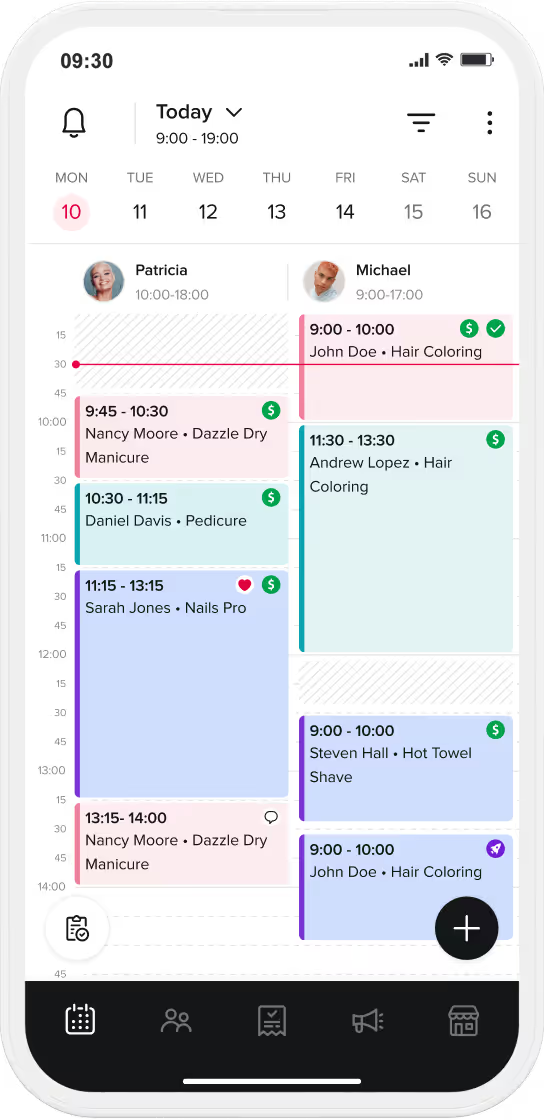
Eliminate excuses about misread paper wall calendars. With the Booksy staff app, employees receive real-time notifications on shift modifications, client cancellations, and new appointments. Managers can set recurring work hours, block off dedicated cleaning times, and review time-off requests seamlessly from their phone or tablet.
2. Automated Commission & Payroll Reporting
Manually calculating service revenue, product commissions, and credit card tips at the end of each week is tedious and prone to human error. Booksy Biz calculates tiered employee commissions, backbar adjustments, and tip payouts automatically at the point of checkout. Staff can view their daily performance stats, fostering healthy competition and full wage transparency.
3. Granular Staff Permission Levels
Protecting proprietary salon client data is a vital policy requirement. Booksy allows salon owners to assign customized permission roles. For example, junior stylists can view their personal schedules and enter technical formula notes without having permission to export client phone numbers, alter master pricing menus, or access overall salon financial reports.
Establishing clear salon rules for employees creates an orderly, productive, and profitable environment where your team can thrive. By pairing a well-crafted handbook with the automated operational power of Booksy Biz, you build a resilient brand protected against workplace misunderstandings.
Ready to automate your salon scheduling, commissions, and staff management? Start your free 14-day Booksy Biz trial today.
Frequently Asked Questions (FAQ)
What is the purpose of an employee handbook for a hair salon, nail studio, or barbershop?
The primary purpose of a salon employee handbook is to establish operational consistency, ensure State Board sanitation compliance, streamline new-hire onboarding, and provide legal protection through signed At-Will Employment agreements and clear dispute escalation procedures.
Can salon owners enforce a dress code and set working hours for 1099 booth renters?
No. Under IRS and US Department of Labor guidelines, 1099 booth renters are independent commercial contractors. Mandating specific working hours, break schedules, uniforms, or mandatory staff meetings can lead to costly worker misclassification lawsuits and tax penalties. Employee handbooks apply exclusively to W-2 staff.
What should a salon owner do if an employee refuses to sign the salon rules handbook?
Hold a private meeting to clarify concerns. In an at-will employment state, signing the handbook acknowledgment confirms that the employee understands and agrees to abide by operating standards. If an employee outright refuses to adhere to reasonable workplace rules and State Board hygiene protocols, you have the legal right to terminate employment.
What are specific sanitation rules required for nail salon employees in the US?
Nail salon staff rules must enforce single-use disposal for porous implements (emery boards, buffers, pumice stones), complete sterilization of metal tools in autoclaves or hospital-grade EPA disinfectants, active use of station dust collectors, and documented mechanical cleaning logs for all pedicure foot spas between every client.
Can salon managers participate in an employee tip pool in the United States?
No. Under the federal Fair Labor Standards Act (FLSA), salon owners, managers, and any personnel with supervisory hiring or scheduling authority are strictly prohibited from receiving payouts from an employee tip pool, even if they contribute to front-desk checkouts or guest reception.