For nail salon owners, a packed schedule may give them the impression that their business is thriving. But in 2026, full chairs do not always lead to a full bank account. The nail industry is a business of micro-margins, where profit leaks away through hundreds of tiny inefficiencies—from excessive product waste to mispriced nail art and dead time in the calendar.
The difference between a skilled technician and a profitable entrepreneur lies in understanding profit engineering. Instead of focusing on adding hours, successful businesses ensure that each minute creates a maximum profit. This guide will take you through the hard math behind pricing, operational costs, and the strategies needed to increase your margins without simply working harder.
1. The Unit Economics of a Manicure: Understanding Your Costs
To master profitability, you must first deconstruct the cost of a single service. Many owners set prices based on the salon down the street, but true profit starts with knowing exactly how much it costs you to open a bottle of polish for any given client.
Direct vs. Indirect Costs
Every service carries two types of financial weight, and accounting for both helps improve your business's margins.
- Direct Costs (Variable): These are the supplies used for a single client. This includes consumables like files, buffers, and lint-free wipes, as well as the chemical cost (the precise amount of base coat, color, and top coat used).
- Indirect Costs (Fixed): These are your overhead expenses that exist regardless of how many clients you see. Rent, electricity, insurance, and nail salon software subscriptions fall into this category. To find your true margin, you must calculate your overhead per hour and apply it to every appointment.
The Per-Service Cost Analysis
Profitable nail salons treat backbar inventory like a laboratory. You should know the cost of every drop of product.
- The "Penny" Breakdown: A single nail file might cost $0.50, and the chemical cost for a gel manicure might average $1.20. While these seem small, ignoring them across 1,000 appointments a year means losing $1,700 in "invisible" costs.
- Product Waste: Over-dispensing product is a silent profit killer. Using 20% more product than necessary due to poor technique or lack of precision tools (like digital scales or measured pumps) can be the difference between a 10% and 15% profit margin at the end of the year.
Labor Cost Realism
Your technicians’ time is your most expensive inventory. When calculating unit economics, you must include the cost of labor plus taxes and benefits.
- The "Non-Productive" Hour: If a technician is paid by the hour but has a 30-minute gap in their schedule, the cost of that seat doubles for the remaining working time. Understanding the cost of an idle chair is essential for setting a price floor that ensures you never perform a service at a loss.
2. Strategic Pricing: Moving Beyond Market Average
Setting prices in a nail salon is often treated as a reactive task—owners look at what the salon down the street charges and deduct five dollars to stay competitive. In 2026, this is a blueprint for failure. To build a high-profit nail bar, your pricing must be proactive, reflective of your technical overhead, and anchored in the value you provide to the client’s lifestyle. (To simplify this process and find your true baseline, you can map out your exact costs and margins using our salon pricing calculator.)
The Failure of Competitive Benchmarking
When you price based on your competition, you inherit their financial problems. You don't know their rent, their debt load, or if they are even making a profit.
- The Race to the Bottom: If your only USP (Unique Selling Proposition) is being "affordable," you attract the least loyal clients—those who will leave the moment another salon opens with a $2 discount.
- The Margin Trap: If your neighbor uses low-quality products and lacks a medical-grade autoclave, they can afford lower prices. If you try to match them while maintaining professional standards, you are effectively paying your clients to sit in your chair.
Value-Based Pricing: Charging for the Invisible
In a premium nail salon, the client is paying for far more than just pigment on their nails. Your price must account for the invisible value that ensures long-term retention.
- Technical Longevity: If your manicures consistently last 21+ days without lifting, you are saving the client time and protecting their natural nail health. That expertise carries a premium.
- The Safety Standard: Higher standards of hygiene create a more luxurious salon experience. If you use source-capture ventilation and single-use kits, your pricing should be 10–15% higher than discount salons to reflect the investment in the client’s health.
- Specialization Premiums: Services like Russian manicures, polygel extensions, or IBX treatments require advanced certification. These should never be priced according to a standard menu; they should be positioned as "Expert-Only" services with a matching price floor.
The Complexity Surcharge: Ending the Free Art Culture
The single biggest profit leak in the nail industry is the failure to charge correctly for time-intensive art. A technician spending an extra 10 minutes on "just a little bit of chrome" on every client can lose the salon thousands of dollars in annual revenue.
- Tiered Art Menu: Move away from per-nail pricing, which is tedious to calculate. Instead, use time-based tiers:
- Level 1 (Simple): Stickers, dots, or chrome on 2 nails (Adds 10 mins).
- Level 2 (Detailed): French tips, simple lines, or basic hand-painting (Adds 20–30 mins).
- Level 3 (Master): 3D art, intricate character painting, or multiple techniques (Adds 45+ mins).
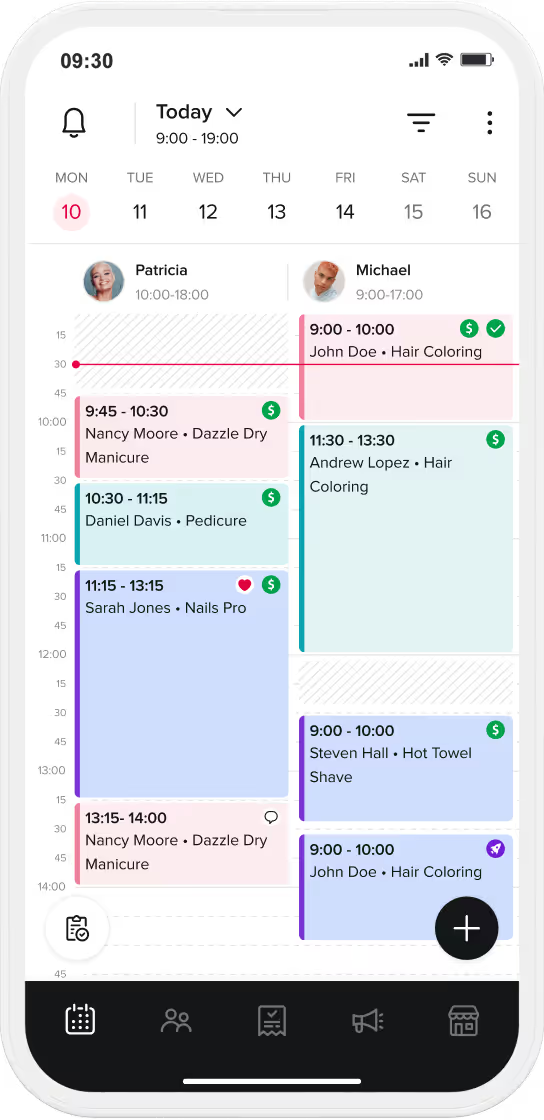
- Mandatory Consultations: For complex art, require clients to send an inspiration photo via your booking app before the appointment. This allows you to block out the correct amount of time and quote a price that guarantees your hourly margin.
| Complexity Level |
Additional Time |
Design Examples |
Pricing Strategy |
| Level 1: Simple |
+10 mins |
Chrome effect, simple dots, or stickers (2 nails). |
Low flat rate |
| Level 2: Detailed |
+20 to 30 mins |
French tips, fine lines, or basic hand-painting. |
Time-block rate |
| Level 3: Master |
+45 or more mins |
3D art, intricate character painting, mixed media. |
Mandatory custom quote |
Tiered Pricing by Expertise: Monetizing Skill
Not all technicians are created equal. A junior tech who takes 75 minutes for a set should not cost the same as a "Master Artist" who can do it in 45 minutes with better precision.
- Junior Level: Lower price point, longer duration. Perfect for price-sensitive clients and for the technician to build their "speed-muscle."
- Senior/Master Level: Higher price point, standard or accelerated duration. Clients pay a premium for the artist’s reputation, speed, and guarantee of perfection.
The Efficiency Bonus: When a Master Artist works faster, the salon’s "Revenue Per Hour" spikes. You should never discount for speed; speed is a premium benefit that allows the client to get back to their day faster.
3. Overhead & The 10% Rule: Managing Fixed Costs
Your overhead takes its cut before you even pay yourself or your staff. In the nail industry, managing the unseen costs is what separates a sustainable brand from a salon that is perpetually breaking even. To maintain a healthy profit, you must keep your fixed costs within strict percentage boundaries.
The 10% Rent Ceiling: Your Location’s True Cost
In a professional nail bar, rent is usually your largest fixed expense. However, a high-traffic location is only an asset if it doesn't swallow your entire profit margin.
- The Rule: Your total occupancy cost (rent + CAM/service charges) should ideally stay between 8% and 10% of your total monthly service revenue.
- The Stress Test: If your rent is $3,000, your salon needs to generate at least $30,000 in monthly sales to hit the 10% threshold. If your rent is consuming 15% or 20% of your revenue, you are in the "danger zone"—either your prices are too low, or you aren't maximizing the productivity of your stations.
| Cost Category |
Target Percentage (KPI) |
Business Impact |
| Rent & Occupancy |
8% - 10% |
Prevents physical location costs from swallowing net profit. |
| Staff & Payroll |
45% - 55% |
Sustains high performance commission without killing cash flow. |
| Usage Inventory (Backbar) |
JIT Maintenance |
Reduces dead cash sitting in low-rotation shades (80/20 Rule). |
Inventory Management: Liquidity vs. The Pretty Bottle Trap
Inventory is cash sitting on a shelf. Every bottle of gel polish that sits unused for six months is money that could have been used for marketing or equipment upgrades.
- The 80/20 Color Rule: Data consistently shows that 80% of a salon's revenue comes from only 20% of its color collection (typically nudes, reds, and classic pinks). Yet, many owners over-invest in seasonal collections that quickly become dead stock.
- Just-In-Time (JIT) Inventory: Move away from stockpiling. Use your nail salon management system to set base levels for essentials like base coats, monomers, and files. Only reorder when you reach a critical low level. This keeps your cash flow liquid and your shelves clutter-free.
Calculating Your Hourly Break-Even Point
Knowing the sales goals you need to reach each month is the best way to reduce financial stress. You should know exactly what it costs to keep your lights on every single hour, regardless of whether a client is in the chair.
- The Formula: Add your monthly fixed costs (rent + utilities + insurance + software) and divide by the total number of hours your salon is open.
- The Reality Check: If your salon costs $25 per hour just to exist, and you have a 1-hour gap in the schedule, you haven't just lost time—you've lost $25 plus the potential profit. This realization is what drives successful owners to prioritize scheduling efficiency and last-minute booking incentives.
Equipment Amortization: Planning for the Future
Nail technology moves fast. LED lamps lose curing power, and E-files eventually need servicing. A profitable owner plans for these "future costs" today.
- The Maintenance Fund: Set aside a small percentage (e.g., 1–2%) of your weekly revenue into a "Sinking Fund." When a $2,000 autoclave or a high-end ventilation unit needs replacing, you can pay for it in cash rather than taking on high-interest debt that kills your future margins.
4. Revenue Accelerators: Maximizing Average Ticket Value (ATV)
To move from surviving to thriving, your nail salon management must focus on two areas: high-margin service add-ons and strategic retail integration. In 2026, clients aren't just looking for a color change; they are looking for a comprehensive hand and foot care experience.
The Upsell Science: High-Margin Service Add-ons
The most effective add-ons are those that take less than 10 minutes but add significant value to the client’s result.
- Structural Upgrades: Offering a "Structure Base" or "Rubber Base" upgrade for $10–$15 adds only 5 minutes to a service but significantly increases the durability of the manicure. The product cost is cents, making this nearly 90% pure profit.
- Spa Transitions: Transition a basic manicure into a luxury treatment by adding a 5-minute paraffin dip or a premium exfoliating scrub. These services use the waiting time (while nails are curing or drying) to generate extra revenue without extending the appointment slot.
- The "Accent" Hook: Instead of selling a full set of nail art, train technicians to offer a "Single Accent Nail" or a "Chrome Finish" during the service. It’s a low-friction impulse buy for the client that increases the ticket price by 10-15%.
| Add-on Service |
Time Required |
Estimated Margin |
Client Perceived Value |
| Structural Base Upgrade |
+5 mins |
~90% |
Flawless nails with no lifting for 21+ days. |
| Premium Paraffin Treatment |
+0 mins (during curing) |
~85% |
Transforms a standard service into a luxury spa experience. |
| Express Accent Nail Art |
+5 mins |
~95% |
Instant customization without major time commitments. |
Strategic Retail: Profit Without the Labor
Retail is the only part of your business that isn't limited by the number of hours in a day. If you aren't selling products, you are leaving passive profit on the table.
- Prescriptive Selling: Don't sell products; prescribe them. If a client has dry cuticles, the technician should explain how a specific cuticle oil will maintain the manicure’s longevity. When a professional provides a solution to a problem, it feels like care, not a sales pitch.
- The 20% Retail Goal: A healthy, profitable nail salon should aim for retail to account for at least 15-20% of total revenue. Since retail has a fixed cost of goods and requires no labor time, it is the most efficient way to pay your rent.
- Bundled Aftercare: Create "Manicure Maintenance Kits" that include a mini-file, oil, and hand cream. Offering these at a slight discount during the first visit encourages habit-forming behavior and ensures the client's nails stay in top condition until their next 3-week appointment.
Premium Upgrades: Tiering the Experience
Profitability also comes from segmenting your clients based on their willingness to pay for convenience or luxury.
- The VIP/Express Fee: In a busy salon, time is your most precious commodity. Consider a "Priority Booking" fee for high-demand slots (like Saturday mornings) or an "Express Service" premium where two technicians work on a mani-pedi simultaneously to save the client time.
- Membership Models: Recurring revenue is the holy grail of nail salon management. By offering a monthly membership (e.g., two gel manicures and one pedicure for a fixed monthly fee), you lock in the client’s loyalty and ensure a predictable cash flow, even during slower months.
5. Financial Monitoring: KPIs for the Modern Owner
To ensure your salon remains a high-performance asset, you need to track these Key Performance Indicators (KPIs) weekly. Your nail salon software should be doing the heavy lifting, providing you with a dashboard that highlights these three critical numbers.
Seat Utilization Rate: The Efficiency Metric
This is the most important number in your salon. It measures the percentage of time your stations are actually generating revenue versus sitting empty.
- The Goal: Aim for a 75–80% utilization rate. If you are at 100%, you are likely underpriced or overworking your staff. If you are below 50%, your overhead is "eating" your profit.
- The Fix: If utilization is low, use "Happy Hour" promotions or last-minute SMS blasts to fill gaps. If it's consistently high, it’s time to increase your prices or add another station.
Client Lifetime Value (CLV): The Loyalty Metric
Profitability isn't built on one-time visitors; it’s built on the 3-week cycle. A client who spends $60 once is a customer; a client who spends $60 every three weeks for a year is a $1,040 asset.
- Retention Tracking: Track your new client retention rate. If 70% of your new clients don't return for a second visit, your nail salon marketing spend is being wasted.
- The Rebooking Gap: Monitor the average time between appointments. If your average client waits 5 weeks instead of 3, you are losing 4–5 full appointments per client, per year. Shrinking this gap is the fastest way to boost annual revenue without finding a single new customer.
Labor Cost Percentage: The Sustainability Metric
In the nail industry, labor is your largest expense. If this number gets out of control, your profit disappears instantly.
- The Target: Your total labor cost (including taxes and commissions) should ideally stay between 45% and 55% of your total service revenue.
- Performance-Based Pay: If your labor costs are too high, consider a tiered commission structure where technicians earn a higher percentage only after they hit a certain "revenue floor." This ensures that the salon's fixed costs are covered before the highest commissions are paid out.
Profit & Loss (P&L) Automation
Gone are the days of manual spreadsheets. In 2026, your nail salon management system should provide a real-time Profit & Loss statement.
- Real-Time Visibility: You should be able to see your "Net Profit" at the end of every week. This allows you to catch "leaks"—like a sudden spike in utility costs or an over-order of supplies—before they become monthly disasters.
- Data-Driven Decisions: When you see that a specific service (like acrylic extensions) has a lower margin due to long labor time, you can make the data-driven decision to either raise the price or provide more training to speed up the service.
The Manager’s Financial Checklist
Mastering your salon's finances is about consistency over intensity. Use this checklist to stay on track:
- [ ] Weekly: Review your Seat Utilization Rate and Average Ticket Value.
- [ ] Monthly: Audit your Inventory and run a P&L report.
- [ ] Quarterly: Review your Pricing and adjust for any increases in supply costs.
- [ ] Annually: Evaluate your CLV and set growth targets for the coming year.
By treating your salon as a financial engine rather than just a place of work, you ensure that your passion for the industry is rewarded with the financial freedom you deserve.
Frequently Asked Questions: Nail Salon Profitability
How often should I increase my prices to maintain profitability?
In 2026, a "once-a-year" price hike is often too slow to keep up with fluctuating supply costs and inflation. Instead, you should perform a mini-audit of your product costs every six months. If your key consumables (gels, prep solutions, or electricity) have risen by more than 5%, a small "inflation adjustment" of $2–$5 across your most popular services is necessary to protect your net margin.
Is it better to pay technicians a flat hourly wage or commission?
Commission is generally the best driver for profitability because it aligns the technician’s goals with the salon’s goals. However, a "hybrid" model is the gold standard for 2026: provide a guaranteed base hourly rate to ensure legal compliance and staff security, then offer commissions on service revenue over a certain threshold. This incentivizes speed, upselling, and rebooking without the salon taking on 100% of the financial risk during slow periods.
Why is my salon busy but I’m still not seeing a profit?
This is almost always due to "invisible leaks" in your unit economics. You are likely suffering from one of three things: mispriced nail art that takes too long, excessive product waste (over-pouring or over-applying), or an overhead-to-revenue ratio that is out of balance. If your rent and labor costs combined exceed 70% of your total revenue, your profit margin is being squeezed out before you even pay for supplies.
Should I charge extra for gel removal?
Yes. Time is your most valuable inventory. A proper, safe removal takes 15–20 minutes, which represents 25–33% of a standard appointment hour. If you offer "Free Removal," you are effectively giving away thousands of dollars in labor every year. Instead, offer a discounted removal fee for returning clients who are getting a new set, but always charge a premium for "Foreign Removals" (removing work from another salon) to account for unknown product types and extra time.
What is a "good" profit margin for a nail salon?
While individual results vary, a well-managed nail bar should aim for a Net Profit Margin of 15% to 25% after all expenses, including your own salary as an owner, have been paid. Salons that focus heavily on high-margin retail and efficient seat utilization can often push this toward 30%. If your margin is below 10%, your business is in a high-risk zone where a single slow month could cause a cash flow crisis.
How can I accurately predict my annual revenue if my salon's traffic fluctuates?
Predicting long-term revenue requires analyzing your average ticket value alongside your historical busy and slow seasons. Instead of manually running complex spreadsheets, you can plug your numbers into our free salon earnings & profit calculator. By mapping out your monthly operational costs against your projected service volume, this tool allows you to track potential revenue streams and set clear, realistic financial milestones for your business throughout the year.