A bustling floor, a steady hum of clippers, and a waiting area full of clients feel like proof of a thriving business to many barbers, but net margins frequently tell another story. Profitability, in reality, is a direct byproduct of time optimization.
The service floor of a barbershop functions like a precision manufacturing assembly line. Your most expensive, high-leverage inventory is not the premium hair clay or the artisanal aftershave sitting on your retail shelves—it is the billable minute. Every moment a barber chair sits empty while the staff is on the clock represents a permanent, unrecoverable loss of revenue.
Minimizing idle time between appointments is the fastest way to increase your average revenue per hour without forcing your team to compromise their craftsmanship or rush their premium service delivery. This guide provides a blueprint to reclaim your calendar, streamline your physical transitions, and maximize the financial velocity of every chair on your floor.
In isolation, a ten-minute gap in a barber’s daily schedule seems entirely harmless, a moment to check a smartphone, grab a coffee, or chat with a colleague at the reception desk. However, when these micro-gaps are left unmanaged and allowed to scatter randomly across a weekly calendar, they aggregate into a massive, invisible financial leak that directly suppresses shop growth and team commissions.
To understand the true scale of floor friction, you must look past the individual appointment and calculate the compounding math. Consider a medium-sized barbershop operating with five active chairs, open 300 days a year. If loose booking habits or sloppy service transitions allow just three random 10-minute gaps to slip into each barber's schedule per day, the shop is quietly bleeding 30 minutes of billable time per chair, every single day.
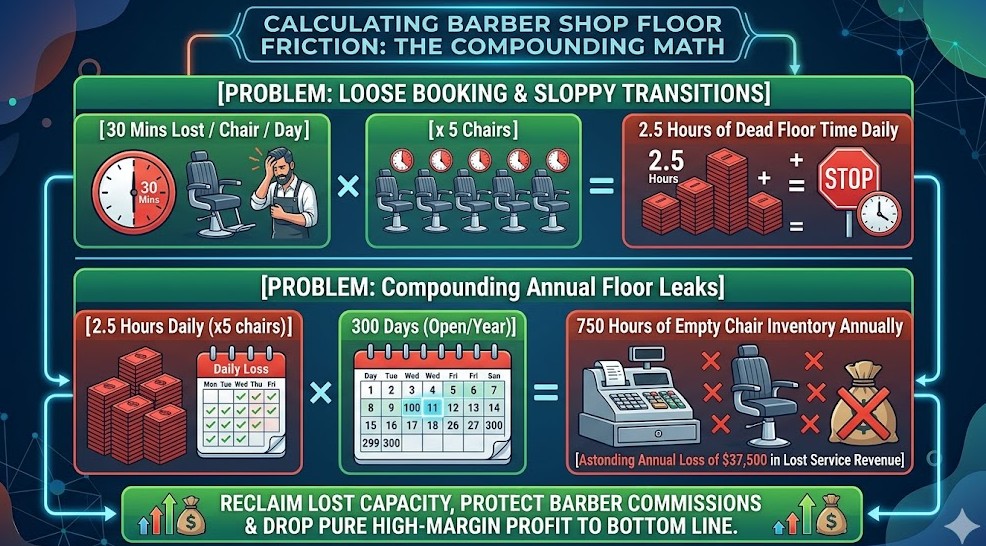
Now, map those 750 lost hours to your financial reality. If your shop’s baseline rate for a standard premium haircut and express style is $50, those unmanaged calendar leaks are costing your business an astonishing $37,500 in lost service revenue every single year.
This estimate doesn’t account for missed retail upselling opportunities or secondary service add-ons. What makes this loss particularly devastating is that your fixed overhead costs—your commercial rent, insurance, software subscriptions, and utility bills—remain completely unchanged whether that chair is filled or empty. Reclaiming those lost 10-minute blocks doesn't increase your operational costs; it drops pure, high-margin profit directly to your bottom line.
To eliminate this leak, shop owners must learn to distinguish between two distinct types of non-billable floor time: unbooked windows and productive friction.
True capacity optimization is not about turning your barbers into exhausted robots working without a second to breathe. Rather, it is about completely eradicating unbooked windows through intelligent digital scheduling while engineering your productive friction so that it occurs with absolute speed and efficiency. Your goal is a highly condensed, predictable floor workflow where every non-billable minute serves a clear purpose.
Making the most of the chairs in your shop requires looking at your physical workspace through the lens of industrial ergonomics. Some of the time lost between clients is caused by mechanical friction—barbers hunting for misplaced tools, searching for clean linens, or utilizing inefficient cleaning methods. By standardizing the turnaround process, you can uphold your health and safety standards while getting your next paying client into the chair quickly.
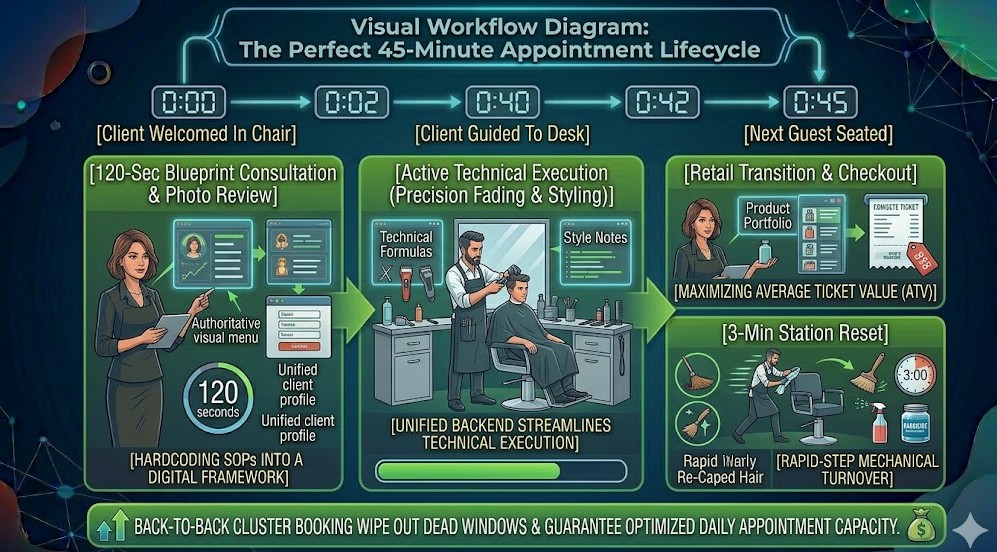
Sanitation is non-negotiable, but it should never become a speed bottleneck. A high-yield barbershop must replace casual, disorganized cleanup habits with a standardized, multi-step mechanical reset protocol that your team can execute flawlessly in 180 seconds or less.
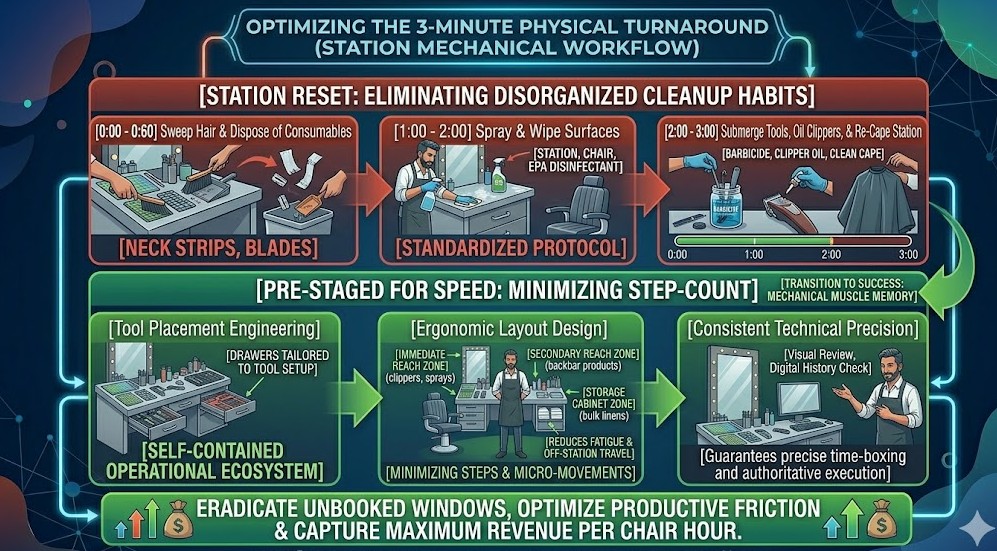
To achieve this 3-minute standard without compromising on local health department codes, the physical station must be pre-staged for speed. Spray bottles featuring premium, fast-acting EPA-registered disinfectants must be placed in identical positions at every station. Brushes, clippers, and guards should have dedicated, labeled zones. By breaking the reset down into an exact mechanical sequence, the physical turnaround becomes muscle memory. This standardizes your shop's presentation, protects your guests from cross-contamination, and saves precious minutes at every single transition point throughout the day.
Every step a barber takes away from their primary workstation to retrieve a fresh cape, grab a clean towel, or search for a specific clipper oil slows down their operations. Tool placement engineering is the practice of structuring a workstation so that the most frequently utilized implements are always positioned within the barber's natural, immediate reach.
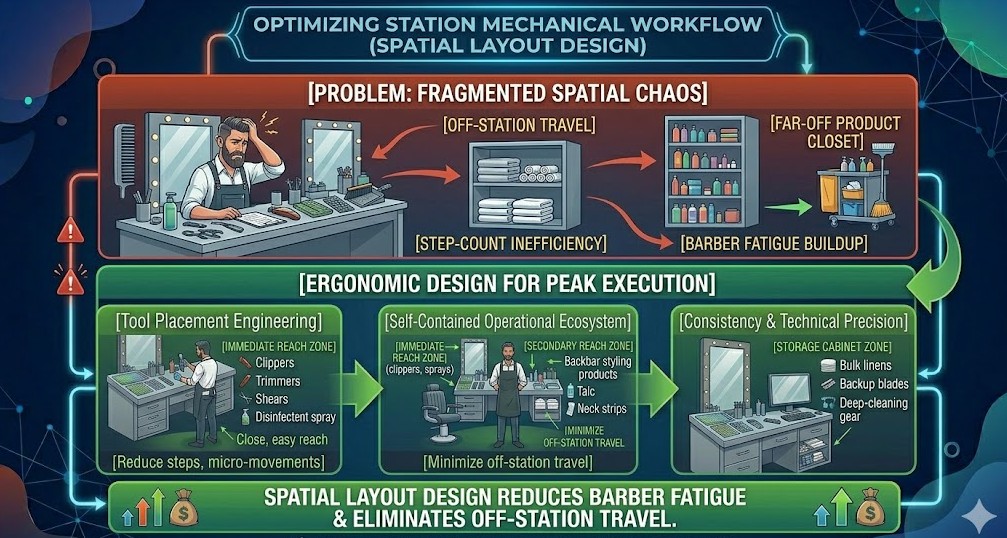
Barbershops should avoid shared tool areas and centralized supply closets for everyday items. Each workstation can function as a completely self-contained operational ecosystem. Drawers should be customized with molded foam inserts or compartmentalized trays tailored to the barber’s primary tool setup.
Furthermore, the station mirror and lighting arrays must be configured to eliminate shadows, allowing the barber to check their symmetry instantly without having to constantly reposition the hydraulic chair or step away to view the cut from a distance. Minimizing physical steps and reducing micro-movements keeps your barbers focused entirely on execution, directly reducing fatigue while naturally accelerating the physical chair turnaround.
Mastering the mechanics of a fast chair turnaround requires more than just optimized tool placement; it demands strict control over the social dynamics of the service floor. Barbershops are historically viewed as community hubs where clients lounge, converse, and decompress. While cultivating a welcoming brand culture is essential for guest retention, it creates a psychological barrier when it interferes with floor efficiency.
Left unchecked, the relaxed atmosphere can warp your schedule, turning sharp, time-boxed services into bloated, unprofitable social calls. To protect your revenue, you must implement assertive service design—structuring the client journey so that transitions occur naturally, politely, and on schedule.
One of the most persistent operational drains on the service floor is the client who refuses to leave the chair once the service is complete. Whether they are finishing a conversation, reviewing their haircut in the mirror for an extended period, or simply using the comfort of the hydraulic chair to scroll through their phone, this delay blocks your next booking. Every minute a finished client spends sitting in that chair is a minute your barber spends trapped, unable to begin the station reset.
To solve the "chair lingerer" problem without breaking hospitality standards, you must use clear physical and behavioral cues that signal the completion of the appointment:
The first two minutes of client visit are also critical to appointment efficiency. Indecision during the opening consultation can easily derail a tight schedule. When a client sits down and vaguely states, "I want something different, but I'm not sure what," a 30-second confirmation can quickly devolve into a 10-minute brainstorming session. This delay eats directly into your cutting time, forcing the barber to either rush the service or run late for the rest of the day.
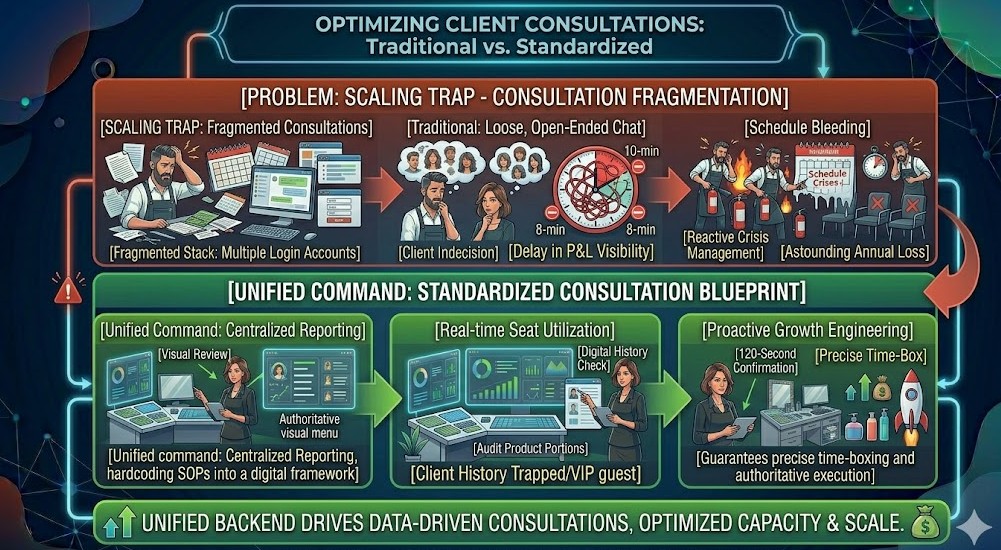
To eliminate this bottleneck, your shop must standardize the consultation process into an 120-second framework. Barbers must avoid broad, open-ended questions like, "What are we doing today?" Instead, they should lead with proactive, visual prompts: "Are we maintaining the mid-skin fade from your last appointment, or are we adjusting the top length today?" Staff can use their barbershop management software to review the client’s digital service profile before they even sit down. Instantly reviewing historical style notes, past haircut numbers, and reference photos completely eliminates guesswork, allows the barber to gain authoritative control of the conversation, and protects the boundaries of the time-boxed appointment.
Physical speed and smart client management are critical, but the battle for chair efficiency is ultimately won or lost inside your digital booking engine. You can have the fastest, most ergonomic shop floor in the industry, but if your online calendar is poorly structured, you will still suffer from massive revenue loss due to calendar fragmentation.
Fragmented calendars occur when booking software allows clients to select random, scattered times throughout the day, leaving isolated 15-minute and 20-minute gaps that are impossible to fill with standard services.
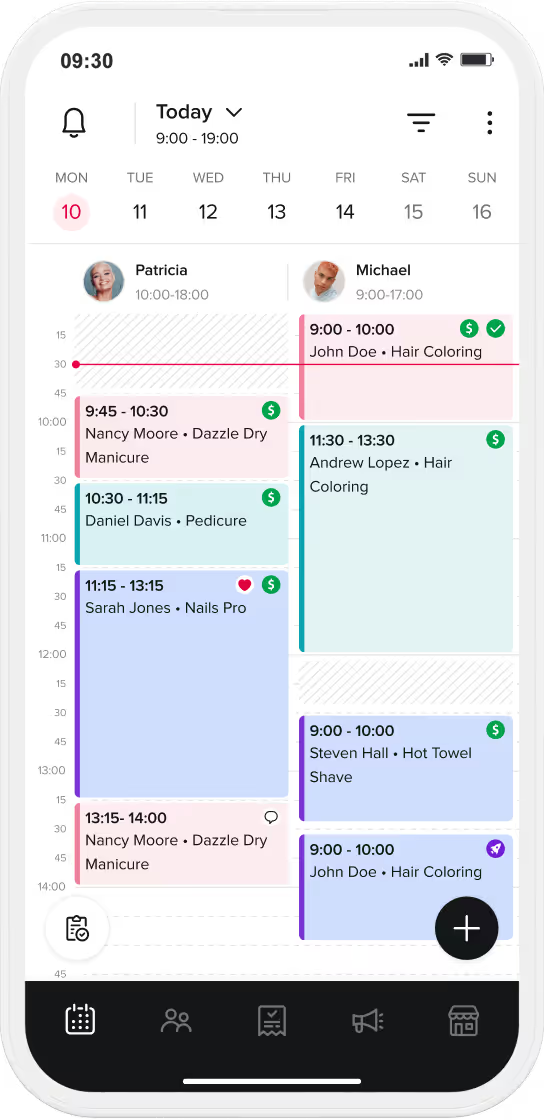
Traditional, unoptimized booking software operates on a reactive, first-come, first-served basis. If your shop opens at 9:00 AM, a client can jump online and book an appointment at 10:15 AM. This single selection instantly breaks your morning schedule, creating a dead 15-minute window beforehand and another unfillable gap afterward.
To eliminate these dead windows, high-yield shops implement the Cluster Booking Method through intelligent scheduling algorithms:
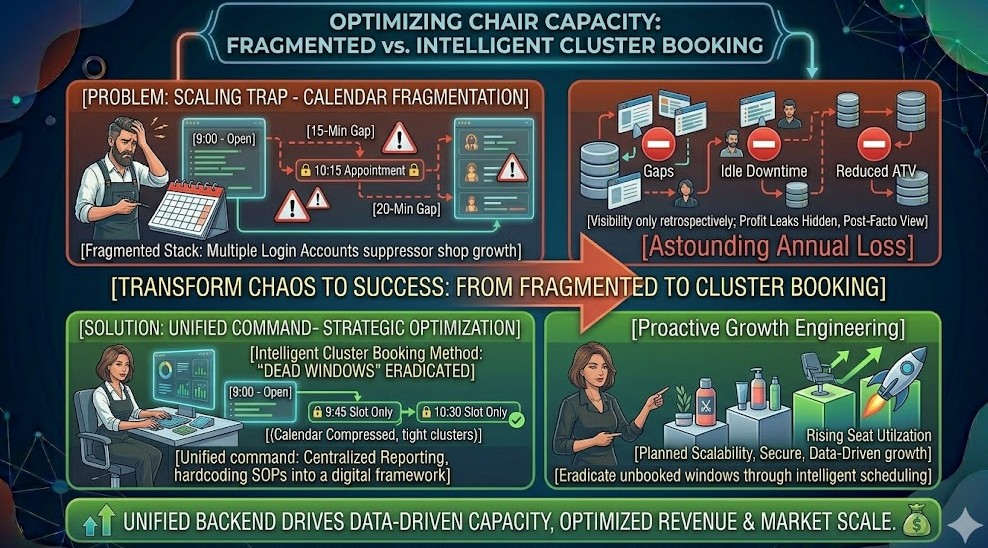
Instead of displaying every single open time slot on your public booking page, your software engine must restrict client options to slots that directly touch existing appointments or shift boundaries. If a barber has an appointment from 9:00 AM to 9:45 AM, the software will actively push the next online booker to select 9:45 AM or 11:15 AM, rather than allowing them to drop a pin right in the middle of a blank space.
Condensing your daily slots into tight, back-to-back clusters systematically wipes out dead windows, guarantees a smooth, continuous workflow for your barbers, and maximizes your total daily appointment capacity.
A major mistake many shop owners make when configuring their scheduling apps is adding uniform, permanent padding time (like an automatic 15-minute block) to the end of every single service on the menu. While the intention is to give barbers a buffer for cleanup and admin tasks, this practice often backfires by hardcoding consistent idle time into the calendar.
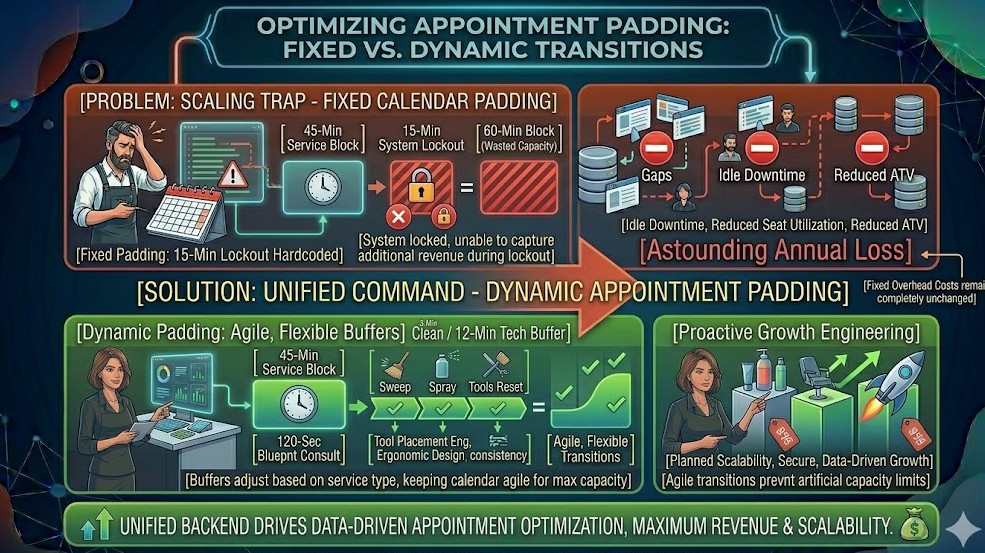
If a standard haircut takes 30 minutes, and you add a mandatory 15-minute block of system padding, you lock out a massive amount of potential floor space over a multi-chair operation. True padding time optimization requires distinguishing between technical cleanup needs and true idle downtime.
Instead of locking out the calendar with system-enforced blocks, configure your software to use dynamic, service-specific buffers. This ensure that easy, low-cleanup services (like a quick beard trim or neck lineup) do not inherit the same heavy padding blocks as a messy skin-fade or a multi-step hot towel shave. Keeping your digital buffers tight and matching them to actual service requirements keeps your calendar agile, prevents artificial capacity limits, and captures maximum revenue per chair hour.
No matter how flawlessly you engineer your shop floor or compress your digital booking grids, your schedule will be affected by client behavior. Late arrivals and outright no-shows are the two greatest disruptors of calendar efficiency in the barbering industry.
When a client arrives 15 minutes late for a 30-minute appointment, they trigger a negative chain reaction across your entire day. The barber is forced to make a terrible choice: rush the cut and sacrifice craftsmanship, or run late for every innocent client booked afterward. To protect your chair turnaround, you must move away from reactive frustration and implement strict, software-enforced booking guidelines.
Many shop owners hesitate to enforce strict schedule boundaries because they fear alienating their long-term, regular clients. But allowing a late arrival to disrupt subsequent appointments doesn't preserve loyalty—it simply shifts the negative experience to your punctual VIP guests. Protecting your brand's reputation requires establishing a clear, standardized cut-off policy.
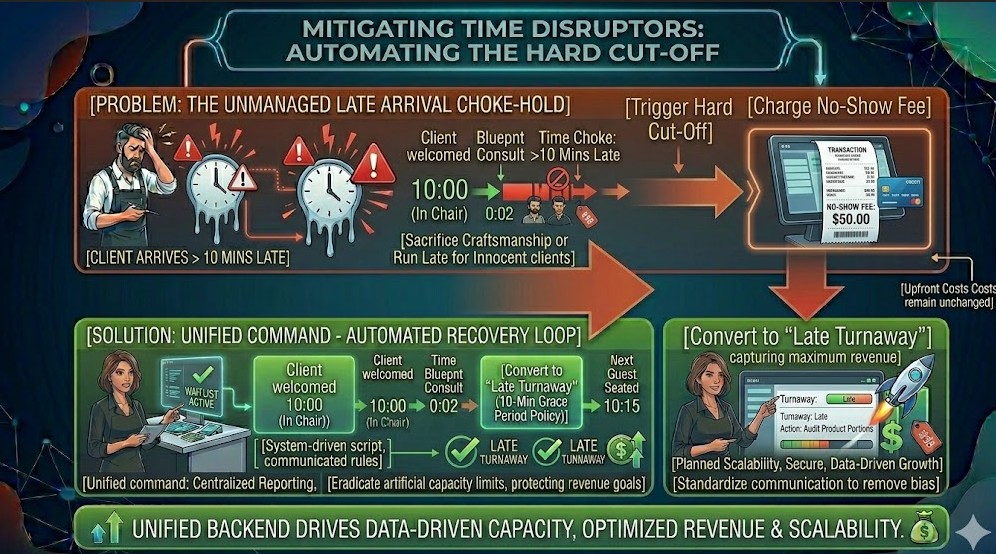
The industry gold standard is a strict 10-minute grace period. If a client passes this window, the appointment is automatically flagged by the system as a "Late Turnaway." To enforce this rule gracefully without offending the client, your staff must shift the responsibility from personal bias to system automation:
Even with clear policies, last-minute cancellations will still happen. In a traditional shop setup, a cancellation at 11:00 AM for an 11:30 AM slot results in a dead, unrecoverable loss of revenue. The barber sits idle, the chair stays empty, and the profit margin vanishes.
To combat this, modern shops use an Automated Fill-In Engine powered by broadcast marketing to immediately turn cancellations into cash:
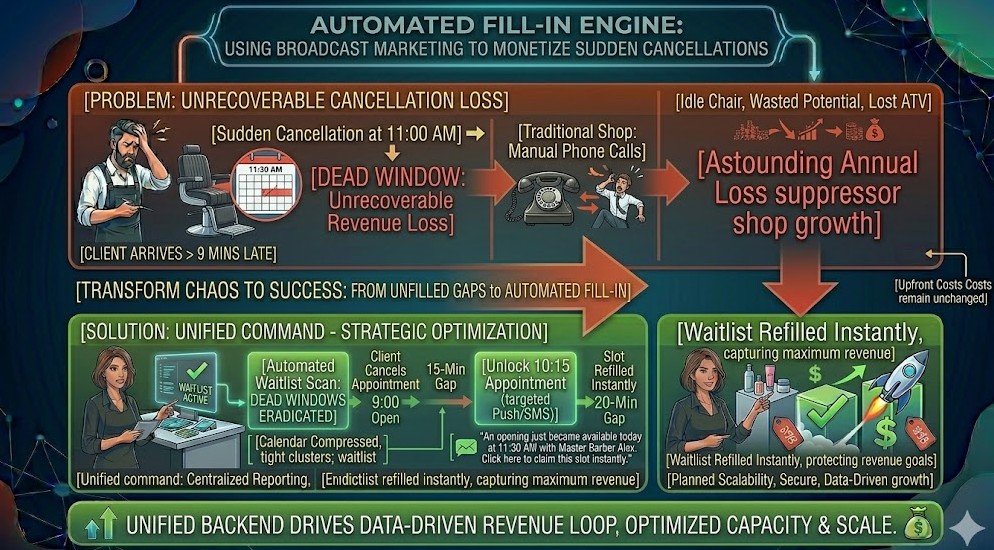
The moment a client cancels a booking online, your platform shouldn't just leave a blank space in the calendar. It should instantly scan your digital waitlist—a queue of clients who explicitly requested an alert if an earlier opening appeared.
The barber software automatically sends a targeted blast notification via SMS or push alert to those waiting clients: "An opening just became available today at 11:30 AM with Master Barber Alex. Click here to claim this slot instantly." Automating your waitlist communication creates a high-velocity recovery loop that fills empty chairs within minutes of a cancellation, completely bypassing manual phone calls and protecting your daily revenue goals.
Operational scale is achieved when efficiency is tracked, measured, and incentivized across your entire staff. In a modern barbershop, speed should never be viewed as a negative metric that compromises quality. Instead, precision speed must be positioned as a premium business asset.
By utilizing cloud-based shop data, owners can track floor velocity in real time, pinpoint bottleneck patterns, and reward barbers who maximize their revenue potential per hour.
You cannot optimize what you do not measure. To systematically eliminate idle chair time, a shop owner must move past visual observation and rely on deep data analytics. A professional multi-chair dashboard streams live operational metrics from your point-of-sale (POS) data to track your Seat Utilization Rate—the exact percentage of time a chair is generating service fees versus sitting empty during open business hours.
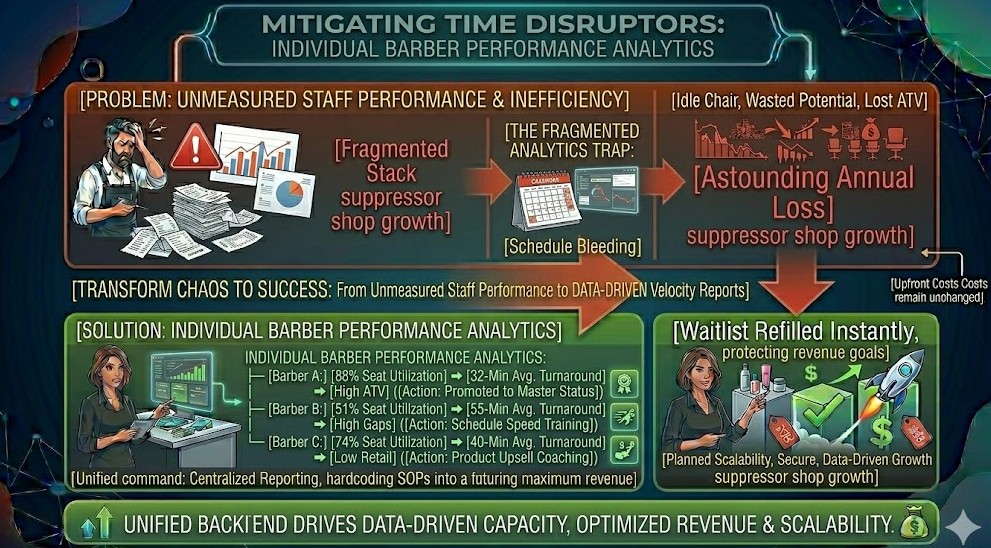
Reviewing these reports weekly allows you to analyze individual staff work velocity and pinpoint bottlenecks. For example, if the data reveals that Barber A has a 85% utilization rate with an average service duration of 35 minutes, while Barber B has a 55% utilization rate because their standard cuts routinely stretch to 55 minutes, you have clear insight.
This analytical approach allows you to step in with specific, practical technical training to help slower team members speed up their clipping transitions, standardise their cutting methods, and improve their overall efficiency.
The final piece of the turnaround puzzle is aligning your staff's financial incentives with your shop's efficiency goals. Traditional commission splits simply pay a percentage of the total services rendered. While this encourages upselling, it doesn't incentivize barbers to manage their calendar time effectively or minimize the transition gaps between clients.
To drive floor velocity, structure your pay around Revenue-Per-Hour (RPH) performance tiers:
Tying commission rates directly to calendar velocity completely transforms your shop's culture. Your barbers start looking at 10-minute gaps as direct obstacles to higher pay tiers. The staff becomes motivated to optimize their station resets, start consultations promptly, reduce idle downtime, and keep your chairs moving at maximum profitability.
Building a highly successful, sustainable barbershop is a transformation that requires shifting your focus from pure artistry to operational data. Craftsmanship and a welcoming shop culture will always be the heart of your business, but structured time organization is the engine that drives true financial growth.
Every unmanaged 10-minute gap, long client consultation, or slow station reset is an invisible leak draining your business's bottom line. By redesigning your physical stations for speed, using cluster booking methods to compress your calendar, and deploying automated safeguards against late arrivals and cancellations, you eliminate the friction that holds your business back.
Do not allow your hard-earned revenue to slip away through a fragmented calendar. Turn time into a premium asset, back your business operations with an enterprise software platform like Booksy, and build a high-performance barbershop engineered for maximum efficiency, long-term growth, and clear financial freedom.
Calendar fragmentation occurs when online booking software allows clients to select random, scattered times throughout the day, leaving isolated 15-minute or 20-minute gaps. These micro-gaps are impossible to fill with standard services. When multiplied across several chairs and hundreds of working days, these unmanaged gaps aggregate into an invisible financial leak that cost thousands of dollars in lost service revenue annually.
Instead of displaying every open time slot on your public booking page, the Cluster Booking Method uses intelligent scheduling algorithms to restrict client options. It actively pushes online bookers to select slots that directly touch existing appointments or shift boundaries (e.g., booking right after a 9:45 AM finish rather than dropping a pin at 10:15 AM). This compresses the calendar and systematically wipes out dead windows.
An unbooked window is systemic waste—a dead block of time caused by fragmented scheduling that provides zero operational value. Productive friction, conversely, is the structured, intentional time required to reset the station, sterilize implements, and execute administrative tasks. True capacity optimization is about completely eradicating unbooked windows while engineering productive friction to happen with absolute speed.
To move a finished client out of the hydraulic chair and into the retail zone, barbers should use clear physical and behavioral cues. First, execute the "Un-Capping Hand-Off"—immediately remove the cape, step back, and extend an arm toward the retail area. Second, use the "Direct Product Hand-Off"—place the specific styling product used during the service directly into the client's hands and guide them to the front desk to bundle it with their checkout.
The industry gold standard is a strict 10-minute grace period, after which the booking app automatically flags the slot as a "Late Turnaway." To enforce this without hurting loyalty, staff must shift the responsibility to system automation. Use a script like: "Our booking engine automatically locks out the slot after 10 minutes to prevent overlapping delays for other guests." This rule must be transparently hardcoded into all automated SMS and email reminders.